Showing posts with label Pheasant. Show all posts

Monday, January 16, 2017

Rabbit and Pheasant Leg Meat Pie

     One of life's greatest comfort foods is a nice chicken pot pie. At least, to me anyway. But a nice thick meat pie of just about any variety is pretty satisfying too. Not a pot pie with veggies and gravy inside, but entirely filled with meat, then smothered with gravy.  Last December, when I was in England I had the opportunity to eat a couple of meat pies; one a pork haggis pie, the other a game pie. Both were delicious. Inspired by the memory of these delicious pies, I decided it was time to pull a bit of game out of the freezer, and get busy.

     I decided I'd use a rabbit, and some pheasant legs I'd put aside. Rabbit is a very delicate meat, with a rather sweet flavor. It also cooks and strips off the bone easily. Pheasant legs are a piece of the bird many people don't use. They can be tough to deal with because unlike chicken or other birds, they've got 3, rather than 2 tendons, running up the leg. The tendons tend to harden when cooked. But pheasant legs have a nice, rich, dark meat on them, which compliment rabbit nicely.

     Having decided on which proteins to use for my filling, a plan was hatched. Now, before I get into the play-by-play, rest assured, this recipe is actually quite easy, but time consuming. I didn't make it all in one day. One day I made my meat filling, and the next I assembled the pie. Also, despite my trip to England fueling my desire for a meat pie, the flavor profile of this dish is more continental, French in particular. Anyway, let us begin.

You will need:

1- Rabbit
4- Pheasant legs
4 cups- chicken stock
2-4 cups white wine
1/2- finely chopped onion
1- finely chopped carrot
2 sticks- finely chopped celery
Thyme, Parsley, Sage
cooking oil
3-4 cups slice mushrooms
Flour
butter
Salt & Pepper
Dijon Mustard
2- frozen deep dish pie crust
1- Egg

Here we go.

     In a large sauce pan heat a bit of cooking oil, and when heated add the onion, carrot, and celery, and begin to brown slightly.

     Once browned slightly add and brown the rabbit. The rabbit should be cut into 4-6 pieces for easier handling and cooking.


     Once the rabbit has browned, add and brown the pheasant legs.

     Once all the meat has browned add the chicken stock, wine, and the herbs, and cook over a medium-hi heat until brought to a boil, then lower the heat and cook at a low boil for a couple hours. 
Cooking down the filling

      When the meat is easily pulling away from the bone, turn off, and remove the meat from the stock to cool. 

     Strain the stock to remove all the herbs and veggies, retaining the stock. Discard the bits and pieces strained from the stock.

     After the meat has cooled, remove all the meat from the bones, discarding the bones and any bits of tendon. Set meat aside.
The Meat

     In a sauce pan reduce the stock to about 1 1/2-2 cups, and sift in flour slowly while stirring until the stock becomes a nice gravy of whatever consistency you prefer.

     The gravy and the meat is then mixed together. Add salt and pepper to taste. The meat should not be awash in gravy, rather just moistened and coated. At this point the meat filling can be put aside and the pie finished another day. 
The Meat Filling

     
     The next step is to cook the sliced mushrooms in butter until softened and browned. Don't go light on the butter. Butter is good. You want the mushrooms to retain a lot of butter flavor.

     Take the pie crust out of the freezer, and defrost for about 15-20 minutes.

     Fill the crust with the meat filling.

     Brush the top of the meat with the Dijon mustard.

     Top the meat filling with the buttery mushrooms.

     Place the other pie crust over the top, crimp the edges, put a few vent slits in the top, and brush liberally with an egg wash.

     Bake on the middle rack at 375 degrees for 40 minutes,........

     ........and enjoy. 

     I brought this pie to the skeet club, and to was on the table very long before the first slice was cut, and everyone was digging in. 


Friday, December 30, 2016

England, Part 2. Musings.

     Since I've been back from my shooting trip to England, last year, I've been giving a lot of thought to the state of driven bird shooting here in the US. Over all, it does not exist. Why not? There are plenty of sportsmen who would give it a try. To a degree the interest is there.

     Around the country numerous shooting preserves hold regular tower shoot where pheasant are released form a tower of some height to fly over the guns who have formed a circle at some distance around the tower. These shoots are usually called European shoots, but truth be told, they are nothing like a driven bird shoot. Some clubs offer a different form of "driven" bird shooting where birds are released from a hill top over a line of guns in a valley below. These shoots often have more than 1 "drive" and the guns move around the property, and change pegs as they would at a real driven shoot. In fact, some of these shoots are quite authentic, like the shooting offered by Royal United company. But it's not "driven" bird shooting. Then there is Blixt and Company. They offer true driven bird shooting out west. Something, however, tells me that this isn't exactly affordable for the average household. Driven bird shooting shouldn't be something that anyone can't aspire to partake of. And it needn't be. The syndicate I shot with in England is a DIY syndicate. The members do all the work. They don't hire a gamekeeper, nor beaters to push the birds over them on shoot day. Before the season they all pitch in and make repairs to the bird pens and feeders. They take delivery of the pheasant poults and care for them. They haul feed, and fill feeders all during the season. On shoot day they split in to 2 teams, red and black, and alternate shooting and beating the cover. This form of syndicate  operates on a walk1-stand 1 format, and is common in the UK.

     What is keeping us from having driven bird shooting here in the US? I think the biggest factor preventing the formation of driven bird syndicates in are the bag and possession limits on game. Unlike in the UK, here the game birds belong to the public, and limits have been established to ensure a fair distribution of the resource, and to prevent game hogging. It'd be hard to get a people involved in a syndicate when they could only shoot 2 pheasant a day. In fact it'd be probably too much effort to organize a driven day for such a small bag. Coupled with the fact that it'd probably be pretty hard to find a property in many states with enough birds to make the day exciting. Here in the east, most pheasant are released by the state, and they aren't exactly releasing all that many. A solo hunter with a good dog has a better chance at killing his limit, in a shorter time, with less effort than would be done working in unison with a syndicate. Of course, a day of driven shooting isn't just about the number of birds killed. Driven bird shooting is a social affair that involves shooting birds. Still, trying to organize a syndicate, and drives when there just aren't many birds around isn't very inspiring, and unless the local arrangements are second to none, I doubt there'd me many repeat customers. But that isn't really too much of a problem. Shooting preserves have long been established, and because they raise, and release their own game birds have been exempt from the bag and possession limits. The special rules for preserves is what allows Royal United to operate, and why tower shoots exist. So why not a preserve dedicated to driven bird shooting?

    I think it's time to form a driven bird syndicate, and get some true driven bird shooting going here in the US. Why not get a syndicate started, and find a property which could be licensed as a shooting preserve, and spend a few weekend each fall doing a little walk1-stand 1 driven shooting? I have a hard time believing that I am the only one in the New England area with an interest in driven birds.

     Here is a link from the Shooting UK website to an article, How to start your own DIY shoot. While I don't think we would need to do everything the way the article suggests, and couldn't do some of it, I do believe that with the right base of people putting their heads together a driven shooting syndicate could be a reality. So, what do you say? If you are in the New England area, and have an interest in driven shooting, and would like to see a syndicate formed dust off your tattersall and tweed, and send me an e-mail.


Wednesday, December 16, 2015

ASO Goes to England, Driven Bird Shooting

     It's long been a dream of mine to travel to The UK to do some game shooting. The UK sports a variety of game shot in a variety of ways, many of which are quite different from the way we do them here at home. There are also many different species, though some are quite similar some found here. For example moors in the north of England and Scotland hold Red Grouse and Black Grouse, two species not found here. In other parts of the country you will find Grey Partridge, and Spanish Red-Leg partridge, birds that are very similar to Huns and Chukar, respectively. There are also Pheasant and Woodcock, but unlike here in the US both species are larger in size, the European Woodcock being nearly 3 times the size of the woodcock we shoot here. The British countryside also has a robust population of Wood pigeon, which looks similar to the Rock Doves we call pigeon. They, too, are a bit larger is stature.

     My dream was finally fulfilled when I won a day of driven bird shooting in England in a small, online auction. It was time to pack my tweed and wellies, and hop on an airplane headed east. I would be spending a day in East Yorkshire, not only participating in a driven Pheasant shoot, but also shooting geese in the morning, and ducks in the evening. And, seeing as I was flying across the Atlantic, I figured a couple days of "shopping" (which is code for visiting gun rooms) in London was in order. So, after some consultation with my host, a plan was formulated, and off I went.

Puttin' on the tweed


     My host, Rick, is an American wingshooting and bird dog enthusiast who has lived in England for some time. As part of the offered shoot, Rick generously put me up at his home for the weekend, and loaned me his 12g O/U, as bringing a gun to the UK, while not impossible is difficult. Spending the weekend at Rick's provided the additional pleasure of eating a couple of his delicious home cooked meals (I think he may have been showing off a bit), and snuggling with his sprightly 11 year old Lab Roxie, and his affectionate 4 year old Wire Haired Vizsla Ruby. As the shoot day was schedules to start well before the sun rose, and end after it set, it was a good idea to stay at Rick's house. Another good idea, was my decision to stop over in Manchester on my way to the shoot. I find it easier, and easier to admit these days that I am not young anymore, and sleep has grown in importance to me. Taking a red-eye flight, and then immediately hopping on a train to the counrtyside would have made me a lousy, groggy guest, so I planned a jet lag management stop over enroute. Though I will admit I had a bit of an ulterior motive in stopping over in Manchester. Regular readers of this blog will recall that last summer I was in Manchester attending a youth soccer tournament.While there I found a couple of places to have a good meal; one a nice dinner, the other a nice breakfast. I would be in need of both a dinner, and a breakfast. And so it was decided; One week of travel to Manchester, East Yorkshire,and London.

Me and Rick prior to going duck shooting

     My travel to Manchester was completely uneventful, and seamless. I was able to check in to my room a bit early, and get in a nice nap before heading out to enjoy a few drinks and dinner with a friend. The next morning I made my way to the cafe I had been hoping to eat my breakfast at, and I was not disappointed. After breakfast I wandered the Manchester Christmas markets a bit before catching the train to Hull where I would meet up with Rick, and the shooting adventure would begin. At Hull Rick found me rather easily, my large suitcase in tow being a great clue, and we made our introductions before heading to Rick's home via a quick stop off at a local gun room. It was there that my education in British game shooting began. The land we would be shooting over is a working farm, the fields of which periodically house sheep. Because of this, and a sheep's willingness to eat absolutely anything, it is a requirement of the land owner to shoot only shotshells with fibre wads, as these wads, if eaten by a sheep will not harm it. Truthfully, I think this a great idea, and have begun researching fibre wad ammo here. Why litter the woods with plastic if we have an alternative?

     Shoot day started off early, well before the sun rose. As we drove to the farm in the darkness, and anticipation, we discussed a more in detail the customs of British game shooting, and the rules, both written and unwritten. Like here at home, safety is the number one concern in the game shooting community. Unlike here at home, game may be shot both before, and after dark. At the barn we met up with a couple members of Rick's shooting syndicate who were also keen to shoot a few geese, and I was soon settled into a sparse hedgerow alongside a field known to be the gathering spot for hungry geese in the morning. Optimistically I sat hoping today would be the day I dropped my first Pink Footed, or Specklebelly Goose.  Before long I had an opportunity in the predawn dark at a pair of ducks flying in from behind. However, the ducks were over and gone well before I even registered the whistling of their wings and saw them. The skies were overcast, making the sunrise seem like it was never going to come, and hampering long range vision, but off in the distance we could see and hear geese doing their thing. Problem was they were doing it way down the other end of the very large field, and well out of shotgun range. It wasn't long after a small flock of geese flew in to the far corner of the field that a shot rang out from the opposite hedgerow where the others were sitting. Shortly after the shot a few geese broke from the tree line and headed somewhat my way. The geese were not coming directly over, but were cross right to left out near the edge of shotgun range. I sent two rounds of steel in their direction, with a net result of zero. Oh well. At least I'd gotten to see, hear, and shoot at, a species I'd never encountered before. It was fun anyway, as water fowling tends to be, and honestly this is how so  many of my homegrown water fowling adventures end.

     With the goose expedition behind us we headed to the barn where we'd have breakfast and I'd meet the rest of the Watton Carrs syndicate. We encountered a small set back at the barn. While Rick had remembered to pack breakfast and lunch, he'd forgotten the pan in which breakfast was to be cooked, so it was off to the farm store for a take out sausage sandwich, which was outstanding, then back to the farm where I'd meet the balance of the syndicate I'd not met at the farm store.

     In Britain shooting organizations take many forms. One of the most common forms is that of a shoot syndicate. Loosely translated, it's a private, organized club. Rick is a member of the Watton Carrs syndicate in East Yorkshire. The syndicate leases the sporting rights to a 2500 acre working farm. Leasing the sporting right gives them exclusive permission to shoot on the property. In the spring the syndicate buys, and releases roughly 700 pheasant on the property. Unlike the standard here in the States where pheasant are released just prior to shooting, the syndicate initially rears the birds in open topped pens, with small exits along the bottom which allow the birds out, but prevents larger predators in. The club sets out numerous feeders in the surrounding wood lots, as well, and soon the birds disperse and take up residence all over the farm. Once released these birds very quickly become quite wild, and strong fliers. The Watton Carrs syndicate is a small, DIY syndicate which does not employ beaters to drive the birds over the line of guns. Rather they work on a stand 1-walk 1 basis. This means in a typical 6 drive day every member will alternate between shooting on 3 drives, and beating on 3 drives, everyone working together to try to achieve the syndicate's goal of a 50 bird day. To do this smoothly everyone is assigned to either the red team, or the black team, which alternate between beating and shooting on every drive. This being the set up would allow me to see how a shoot is run in it's entirety my first time shooting in Britain.

     The driven bird portion of the day was spectacular in every sense. We met up with the rest of the syndicate members on the southern portion of the farm property, a short drive from the main farm. This was where the first 3 drives would be held. Prior to shooting the shoot captain gathered all the members, guests, dogs, and anyone else in attendance and held a quick introduction and safety brief. Members were assigned to a team, and pegs were drawn. Pegs are numbered 1-9, from left to right. While some syndicates have hard fast peg marked by a numbered stake pounded into the ground, Watton Carrs uses a bit more flexibility, and the shoot captain on each team shifts the approximate position of each peg left or right depending on the wind to insure the best shooting possible. After each drive, all the members shift 3 places to the right. I drew #9 in the morning, so I would shoot in the #3 position on my second drive, and the #6 position on my last drive. As it turns out, the # 9 peg on the first drive, Neil's Pen, was a walking gun position. As a walking gun I would walk the field edge, about 25 yards out, parallel to the woods towards the guns, about 10 yards behind the beaters. The job of a walking gun is to take care of any bird that tried to come out the side of the woods and escape back behind the line of beaters. This would actually work out quite well as an introduction to driven shooting for a number of reasons. First, it was very much how we hunt in our uplands, it would also allow me to be within ear shot of Rick (we were assigned to different teams) who could coach me, as he beat, through my first drive, and it would allow me to watch the # 8 gun who was well down the field.


The pre-shoot brief

     It didn't take long for birds to start popping into the sky out of the woods, and before long a big cock pheasant came out the side and curled back towards the hedgerow bordering the neighboring farm. This bird presented well, was a sporting L-R crosser, and was mine. Except for it wasn't, as with I failed to fully disengage the safety, and watched it fly off. My first British flub. I didn't have to wait too long for redemption, when another big cock pheasant tried to make a similar escape, but with a drastically different result, and I had shot my first driven bird in the UK. The remained of the drive was more of the same, with birds trying to make a back door or side door escape. Some were far, fast, and high, and lived to see another day, but an unlucky hen pheasant made the mistake of trying to fly right over me at a bit of altitude. She presented in the typical overhead British fashion, and I killed her with barrels nearly vertical, swinging through, and pulling the trigger a moment after blacking her out with the muzzle. I will admit, I was quite proud of that shot. After the whistle signaling the end of the drive we all walked the area picking up birds that hadn't been picked up by the many Cockers, Labs, Vizsla's and Spinone's in attendance. It was then that I cased the borrowed 12g, replaced it with a stout stick, and took my place in the beating line.

     The next drive was called New Road Woods, and the beating proved to be as much fun as the shooting. Armed with sticks the line moved forward towards the guns making as much noise as possible to push out the birds. The stick, I learned, is not meant for thrashing the underbrush, but for tapping on trees, and blow downs to make more noise. Unlike hunting our uplands, where dogs force tight holding birds into flight, sometimes nearly underfoot, these birds were getting out well in front of the beaters,a behavior no doubt learned by the weeks of syndicate shooting and beating. In fact I heard the report of the guns out front long before I saw the first bird going out. Like the first drive, after about 15 minutes of hooping and hollering, and a bit of gun fire, the final whistle sounded, and the bird collection began.

     Between the second and third drive we stopped for "elevenses". Elevenses is a British tradition of having a pick-me -up and a warm-me-up before lunch. The tailgates of two SUVs functioned as the buffet where we helped ourselves to beef pies, cake, and cheese. To wash it all down was a selection of port, brandy, Irish liquor, and Champagne. Unlike here, where alcohol and guns are overwhelmingly thought to not mix, a short drink often served, and enjoyed responsibly. Indulging is allowed at elevenses. Over indulging, however, is not.

     The next drive after elevenses was a drive called Wetlands. On this drive I was on the #3 peg, standing in the line, out is a well manicured grass field. From my peg I could see the small pond between the stone wall that marked the field edge, and the wood line that served as bird cover. This drive proved to be more challenging, with faster, higher flying birds. The pheasant would break from the distant tree line, and gaining altitude would come through a break in the thin line of trees that followed the stone wall. As soon as the birds cleared the hedge, and looking like they were coming straight over I'd begin my gun mount, and pretty much every bird found fit to curl to the right, putting the wind directly up their rear, right as my face hit the stock, forcing me to quickly readjust my line and swing, and shoot behind them, as they flew over my neighbor down the line. The wind had picked up considerable. So much so that it was impossible to converse from peg to peg, and caused the baffles of my ear muffs to keep closing.  One cock pheasant, however, made the mistake of not curling, and flying over high between me and the neighbor to my left, and I again enjoyed the satisfaction of folding a good bird in flight. A bit later I had a chance to toss lead at a bird through the backdoor as it escaped past the line, and watched it rock in the air, and begin a rapid, yet controlled descent. Sadly this bird had enough momentum to carry it to the treeline, which was the property line, behind us. After the final whistle about 8 of us, with a couple of dogs walked the property line, yet failed to come up with the bird.


The line of guns at the Wetlands drive

          After collecting loading the birds into the shoot wagon our caravan of cars and SUVs headed back to the main property for a quick lunch in the barn before resuming the shooting. When we resumed the shooting I was back on beater duty for the Elwood drive. This drive produced a fair number of woodcock for the guns, one of which Rick killed, as well as lots of pheasant. While Rick shot a couple of pheasant and a woodcock from his peg in the field, another member, Dave, had drawn the peg they call Bombshell Corner (forgive me; initially misremembered this as Car Bomb Corner). Bombshell Corner is a break where a narrow road cuts between two wood lots. When the birds come over they are high, and quick, and only give you a quick snap shot before disappearing into the woods behind you. Dave did well, shooting 4 out of the overhead break. The retrieval of the down birds was a bit tricky, as the area behind the peg was rather swampy, but a team of cockers swarmed the area and picked up every bird in the woods. One black cocker decided to welcome me with the nice delivery of a cock pheasant it had found, though I think the little dog was really more interested in just unloading it's find, and continuing the search.

Shoot captain, Tom, with his Cockers


     My final drive as a gun would be the South Wood drive, and I was plum in the middle on peg #6. On this drive I had a hedgerow to my back as I faced the cover about 100 yards across an open field. Again the birds had the wind behind them, and flew high and fast. This drive provided the added excitement of the birds coming out quickly, one after the other. While on the previous drives I had the luxury of time allowing me to casually pocket spent shells before dropping in new shells. This drive did not.  The bird that just flew over head had another, already out of the trees, somewhere behind it. Shells were ejected into the grass to be picked up later, as I fumbled to get new shells into the gun. This drive was fun, and the kind of shooting one doesn't deserve regularly.  Anyone who wingshoots regularly has missed shots, and missed opportunities that haunt them. Despite this drive not yielding many killed birds, the 9 gun team only killing 3 birds for 63 shots, there was nothing but smiles on the faces of the team. Nothing about this drive would haunt me. Just the opposite; I'd happily shoot it again, and with the same result.

     The line of guns for the South Woods drive were all positioned at the beginning of the beat for the Top Hill drive, which would be our last. So while we waited for the guns to get into position in the next field one of our team members collected our guns, and carried them out to the cars while we prepared to make our final drive by passing around a flask of brown liquid for a well deserved parting shot. Soon we were beating the last hedgerow towards the steady sound of shotgun blasts.

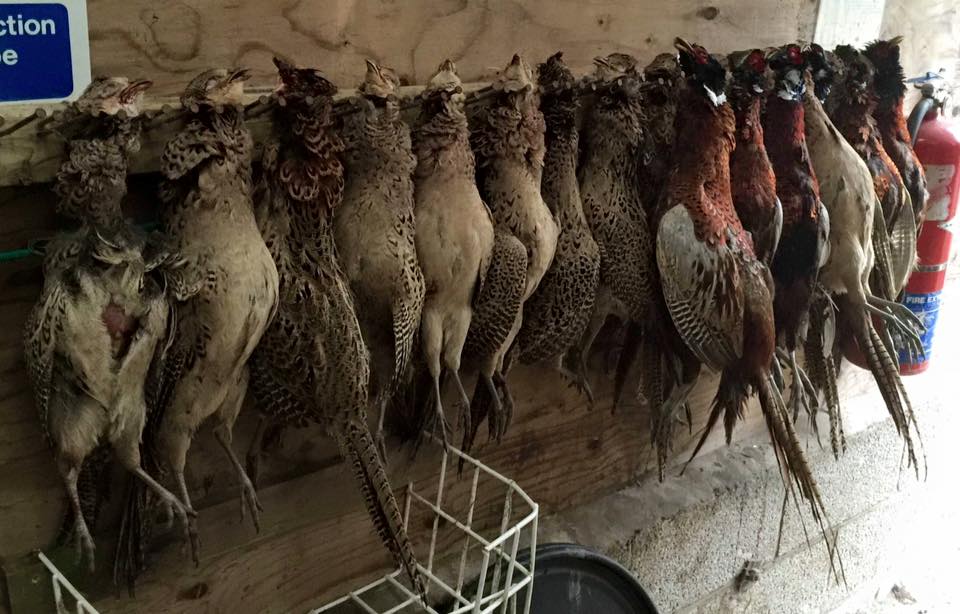
     Back at the shoot barn Tom went through the post shoot ritual of reading off the day's tally. On this day, with 18 guns alternating the shooting, we killed 36 pheasant, and 2 woodcock.


Hanging birds, and a happy beater


     My day wasn't over yet. there were still ducks to be killed, so after a bit of a break, and some minor equipment changes, we made our way to the small pond at the end of the Wetlands drive to wait for the ducks to start coming in. The duck shooting took a very British form, too. Not restricted to daylight shooting hours, we were shooting ducks in the dark. The silhouettes of ducks, coming from behind us in twos and threes would drop quickly into the pond. Then the sky would lighten momentarily with muzzle flash. In most cases the initial shot at the dropping ducks would be a miss, but the follow up shots on the now flaring ducks would cut down at least one, which Roxy the Lab would happily retrieve. Not sure I'd be able to adjust to shooting in the dark, I found that even I could find away to get the muzzles pointed in the right direction, and killed a Mallard. After about an hour of solid darkness, our small team of 5 guns had killed 5 ducks; 2 Mallards, 2 Eurasian Wigeon, and a Teal. And I'd learned that shooting ducks in the dark was both effective and fun. With a full day of shooting behind us, Rick and I cleaned up, and hit the pub (The Pipe and Glass) for an excellent meal, a pint, and a recap of the day.

The evening's duck harvest

     While the shooting was now behind me, the outdoor adventure, and exploration wasn't. As a grouse hunter I've made a bit of a study of the Red Grouse hunting in Britain, and hope to one day shoot Red Grouse either driven grouse from a butt, or behind a good dog. On Sunday Rick and I decided to drive north through the moors hoping to see some Red Grouse. And we sure did see a lot of Red Grouse. In fact we saw 32 Red Grouse, both standing and flying, and a couple of grouse butts. I even had an opportunity to do a little bit of an experiment. I've read a lot that the Red Grouse is the fastest bird in flight, and has the quickest flush. I had to see for myself, finding it hard to believe that anything flushes quicker, or flies faster than a Ruffed Grouse. So when we were presented with a Red Grouse holding close to the road I took the opportunity to wade into the heather and flush it from it's roost. Not wishing to start a Hatfield-MacCoy type of grudge between Ruffie and Red hunters, but there is no way a Red flushed quicker, or flies faster than a Ruffie, though I can see where a Red's low, ground hugging flight could make them tricky to shoot.


The North Yorkshire Moors, and a Red Grouse


     By the time I left Yorkshire for London I couldn't help but think that the UK has some fantastic shooting and, if not for the absence of Ruffed Grouse, might be prefect. Top to bottom I had a excellent trip, and enjoyed the shooting. The atmosphere at the Watton Carrs syndicate was identical to that of my regular grouse camp, and anyone of them would fit in up north perfectly, and vice-verse. Without a doubt I will find a way to go game shooting in Britain again.

An old grouse butt in the moors


Tuesday, March 13, 2012

Action Alert; Mass & Ct Trouble

     Okay, Sportsmen. It's time to make some noise. It has come to my attention that there is trouble brewing in both Massachusetts and Connecticut. It's time to pick up the phone, and write some well crafted letters to the powers that be.

     We'll start in Conecticut. The governor there has decide that in an effort to close a budget gap that he would end the states pheasant stocking program. This is a problem in so many ways. First, pheasant hunting is a great tradition. Many sportsman list pheasant as their number one pursuit in the outdoors. As the state has failed to find ways to manage the wild pheasant population, ending the stocking program would end pheasant hunting in the state. Pheasant hunting is also a great way to start out a newbie or a youngster, and with hunting license sales generally dropping across the country we need a venue like tis to keep the hunting tradition alive. But I think the most disturbing thing about the attack on the stocking program is the fact that it won't really do anything to help with the budget trouble. Pheasant stocking programs are paid for by the hunters. The sale of hunting licenses are where the stocking money comes from.

Here's a link to an article about the trouble in Conecticut. Pheasant Trouble

     On to Mass. A dog loving rep has seen fit to file a bill that would change the way we care for our dogs. Apparently Rep. Cheryl A. Coakley-Rivera thinks owning a couple of mutts makes her more knowledgeable about dog care than the rest of us. She has filed a bill that would limit how you confine your dog. The bill goes so far as to say that a kennel must meet the approval of a building inspector. And get this, dogs will no longer be allowed to be kenneled outdoors between the hours of 11pm, and 7am. The language in this bill makes me sick. The good rep has obviously never visited a kennel of working dog, met or talked to any of the mushers in the community, nor have any understanding of the different breeds.

Here's a link to the bill. Bill H.2809

Yup. It's time to make some noise

Wednesday, February 1, 2012

Things You Should Check Out; This and That.

     It's that time of the year again. With most hunting seasons behind us, and in many places freshwater fishing seasons closed sportsmen are searching for an outlet. That's where the various sporting shows come into play. Two that have captured my attention are:

     The Worcester Eastern Fishing and Outdoor Expo, held at the DCU center in Worcester, Mass. This year the show is held February 10-12th. This is my local show, and I attend every year.

http://www.sportshows.com/worcester/index.html


     Another show which I'm interested in is the National Pheasant Fest & Quail Classic. Held February 17-19th in Kansas City, Missouri, this show is bound to be exciting. Sponsored by Cabelas, as well as Pheasant Forever, and Quail Forever, no doubt there will be lots of good information available. Unfortunately, I will not be in attendance (unless some unexpected funds come along/ All Seasons Outdoors HQ needs a new water heater), so if anyone makes the trip I'd like to hear about it.

http://www.pheasantfest.org/


     The last thing I'd like to feature is Sir Jack's. This up scale, online retailer has a few nuggets which I find are quite interesting, and make an appropriate addition to any hunting, or fishing camp.  Every camp needs a quality cocktail/ mixology book. Sir Jack's has them. Harry Johnson's Bar Tender's Manual not only tells you how to mix, but how to serve, and how to host. In addition, you'll find shooting related flasks, a Warthog tusk cork screw, and some fine upland and trout stream themed stationery for writing invites to camp, and thank you notes. Check it out.

Sunday, November 13, 2011

Kiji Tatsuta

       As thrilling as the hunt is, the time spent in the kitchen preparing and serving a hard won meal can be equally exciting, and satisfying as a heavy game bag. The extent that sportsmen go to, in their efforts to be able to smooth the breast feathers, and feel the heft of a bird delivered to hand by a trusted dog, it's no wonder so many spend as much time perfecting their culinary skills, as their clay scores. Of course, knowing your way around the kitchen also brings with it a certain awe in camp, and almost always assures one will be exempt from doing dishes after the meal.

     With the responsibility of taking game comes the responsibility of creating a masterpiece with it. While it seems these skills improve with age, and bird camp experience, there is always someone who draws the line at doing little more than opening a canned cream of mushroom soup and a bag of onion bits. Coupled with the need for a forgotten appetizer, a culinary whiz in camp is always more than welcomed.

            Of course we all want our game birds to be picturesque center pieces, but let's not forget they make great apps, and snacks too. As a frequent traveler to Japan, and a lover of Asian food, I've found a series of treatments not only suitable for game birds, but pleasing to the American palate too. One of the foods I've adapted is a fried chicken recipe, suitable for either a main dish or an appetizer, called Tatsuta Age (Tah-Tsu-Tah Ah-Gay), but this recipe will work with any white breasted game bird. In Japanese, Pheasant is called Kiji (Kee Jee), so I call this dish, Kiji Tatsuta.

             Tastuta is a dish in which bite sized pieces of chicken are marinated in some basic ingredients, and deep fried to deliciousness. The simplicity of this dish, coupled with the familiarity of deep frying make this dish an easy primer for anyone interested in expanding the flavor profiles of their cooking, and is sure to impress the guys; whether served at hunting camp, or while watching a football game. In addition, two of the ingredients are a staple I use in treating any bird I take that might be hard hit and suffering a little rankness from blood trapped in the meat.

            To start you'll need to take a trip down the international aisle at the grocery store for a couple of provisions, and then detour to the produce section, before venturing into the kitchen. To start with, find yourself a bottle of soy sauce, and a small bottle of cooking sake. Cooking sake is a very low alcohol content rice wine, and should be available at any large grocery store. Should you not find it, any inexpensive bottle of sake from the liquor store will do. I like to keep a large bottle on hand, as it comes in handy for other game handling applications, which I'll explain later. From the produce aisle you'll need some scallions, and a roughly one inch long piece of ginger root.  In addition you'll need to get some oil for frying and some flour, if you don't have it already.

            Taking a look at our ingredients, here's what you should have assembled when it's time to start cooking:
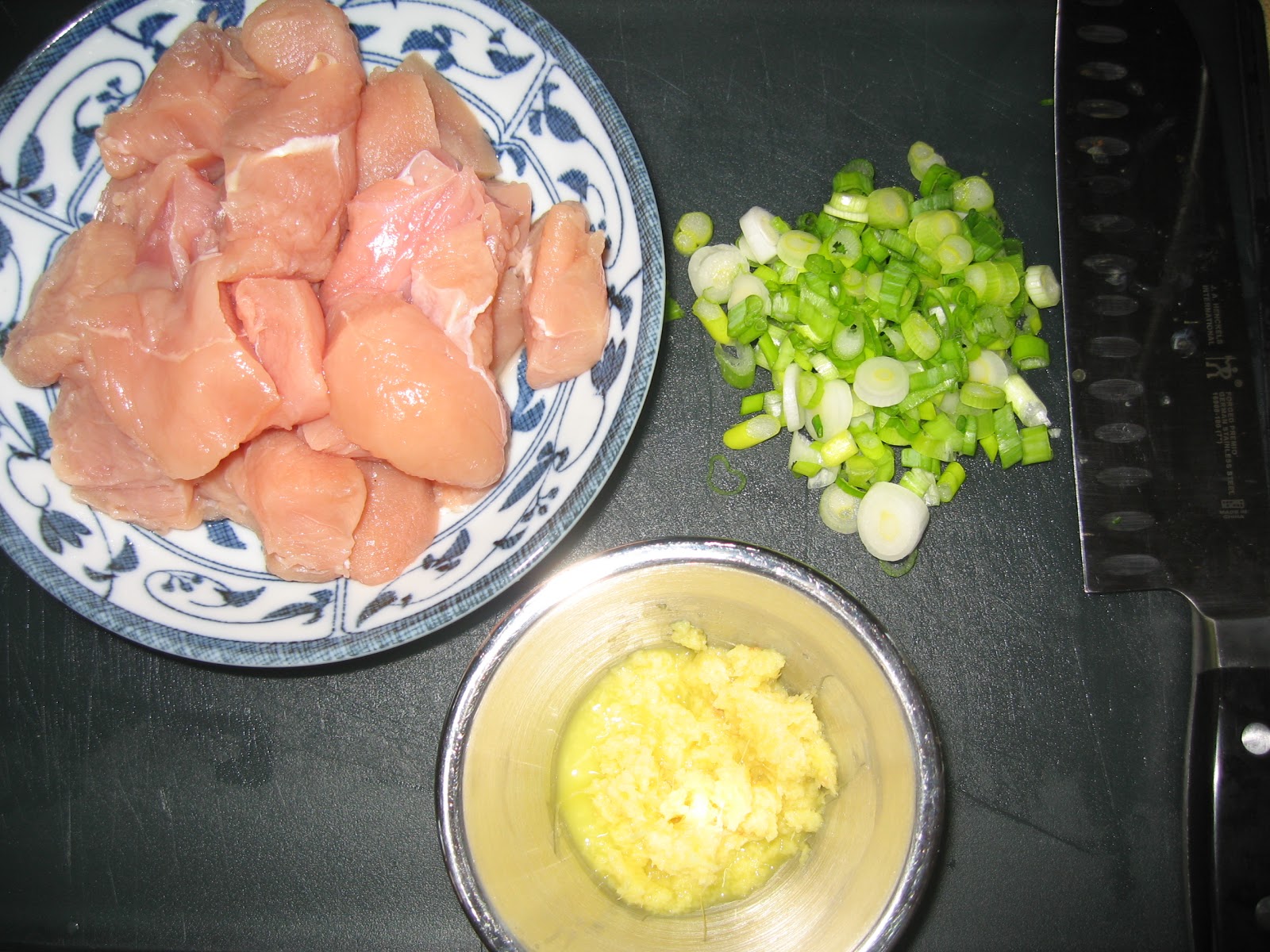
                        The breast meat of two pheasant. Cut into bite sized chunks
                        Soy sauce
                        Cooking sake, or regular sake
                        Ginger root, roughly one inch in size
                        Scallions
                        Flour
                        Oil


           Assembling this dish is quite easy. Put two parts sake, and one part soy sauce in a bowl suitable for marinating. About 2/3 cup of sake, and 1/3 cup of soy sauce should be enough.  Finely chop two scallions, and add to the soy/sake mixture. Next, grate the ginger, retaining any liquid, and add about one tablespoon to the mixture. Ginger can be grated with a small, fine cheese grater, or chopped finely if you have the knife skills. Before grating, you can quickly remove the paper-like skin of the ginger by scraping it off with the edge of a spoon, or you can include it in the dish. After you've assembled, and mixed your marinade, submerse the meat and refrigerate for a couple of hours. When it's time to cook, simply pull a couple chunks of meat from the marinade, allowing bits of scallion and ginger to adhered to it, dredge it in flour, and carefully drop it in the hot oil you've heated until it's fried golden brown.


      This combo of ingredients will give the meat a warming, refreshing accent, which will keep everyone’s fingers traveling from the serving plate to their mouths. The simplicity of this recipe allow for easy modification. More ginger or scallion can be added to suit ones taste, and should you want to make this as a meal, just cut your meat to a larger size and fry a bit longer. The first time you make it, you may want to only use half of the ginger, increasing to your taste as you go.


            In addition, sake is a great treatment for hard hit birds. On occasion, I find that I may have a bird in my fridge, that either from being hard hit, or suffering from a poor diet, has a bit of a rank odor to it. Simply marinating a bird such as this in sake, and a couple 1/4 inch thick rounds of ginger easily removes any unwanted essence, without impacting the flavor.

            Bon appetite.

This is an article I thought was going to be publish, and maybe it will yet. After several issues of the publication going out without it, however, I thought it was time to share it.


Wednesday, September 28, 2011

Upland Tradition; Changing or Fading?

The upland season in nearly upon us here in New England, and I'm ready to go. Recent changes in the form of a puppy rather than a ready to go dog assure me that this season will be different, and is sure to be educational. Not a day goes by when I don't think about stepping out onto the frost covered porch of the cabin, morning coffee in hand, brimming with anticipation of what the coverts will show us that day, while dogs stretch their legs, and turn their noses into the cool northern breeze. Oh yeah. I'm ready to go. But I've got to admit that I feel that something has been lost in the off season. In my efforts to prepare my gear, and ready myself on the clay course, I seem to have lost track of my upland tradition.

While inventorying my toy box I picked up on a trend I hadn't noticed growing, and now fear I've haunted the spirit of the hunt. Mind you, when I speak of upland tradition, and the hunt, I very specifically mean Ruffed Grouse and Woodcock hunting. Grand specimens, genetically predisposed to draw tradition respecting gentlemen of the highest caliber into the wildest of setting. This is why the absence of upland tradition troubles me so. If these birds, the kings of the upland have carried on their tradition why should I abandon mine. Where has it gone?

My inventory has forced me to do a head to toe check, searching, and clinging to what tradition I have left. Hopefully some remains. Some might only be misplaced. But some is gone for good. Had I worn my upland tradition out, and needed to replace it I wouldn't feel so bad, but I'm afraid that might not be the case. So let's take a look.

Starting at the top I am pleased to still be in possession of a well broken in blaze orange LL Bean ball cap. You know, the type with the duck brown bill. So I'm okay there. I feel pretty good in my vest too. Simple and comfortable, I get good use out of a duck brown strap vest. Strap vests are nothing new, so I'm still doing okay.

Things get tricky when it comes time to get dressed, though. Flannel shirts, and sharp looking tattersalls have given way to synthetic, technical shirts that breath, dry quickly, and probably have the shelf life of a cockroach. I'm not feeling much tradition in synthetics. To make matters worse, I've acquired a number of synthetic undergarments to be assured my shirts perform as advertised. What will it be like, not experiencing the tradition of soaking cotton with sweat, and suffering the chill of the northern wind as said sweat evaporates from my back?

Gore Tex brush pants? Yup. They've made their way into the toy box, too. I don't care for hunting grouse in the rain, but the morning dew or a bit of snow clinging to the cover have allowed me the pleasure of soaking my jeans, or trousers, even when protected in a pair of bullet proof chaps. I fear a week at camp will not be the same if I don't get to hang a dripping pair of pants over a railing to dry.

Boots have become less of a problem in my mind, but I'm sure there are still a few uplanders who truly believe the only proper footwear that should be worn in a proper covert is a pair of light weight, moc-toe lace ups. I've switched to rubber Wellies. The switch did not happen over night, as I've been wearing Wellies exclusively for some years now. Faced with the loss of other valuable-to-the-experience "traditions" I fear that I might need wet socks to fill the gap. We'll see?

Gun selection has not changed. I still prefer guns with two barrels. If they've got a straight stock I like them even better. My 20 gauge double will no double be my first choice of accessory, and will no doubt raise the reading on the tradition meter. My sleak little 28 won't be too far away either. The thing is, I've got a 12 gauge stack barrel with a pistol grip that I've been shooting rather effectively at skeet. The idea was to warm up the gun a little for it's intended purpose of waterfowling. I fear it may make it's way into the grouse woods. Compounding the matter, as I work on plans which should see me hunting pheasant in Kansas, where the 12 would fit right in, I keep being pestered with the thought of bringing my 12 gauge pump. It's a nice 12, which I shoot well, and have done some damage to waterfowl with. It was a gift from my father, which though I rarely shoot it these days, I cherish. A trip to Kansa with this gun, to shoot big, corn fed, wild Ringnecks might make a fitting tribute. But now I've gotten off track; which gun I shoot in Kansas won't matter, as everyone knows pheasant hunters don't have any upland tradition.

Friday, February 4, 2011

A Burn's Night Special, Haggis Stuffed Pheasant Breast

Burn's night has come and gone this year, and not many people noticed. I usually find Burn's night to be a great excuse to drain a malt that's been sitting in the liquor cabinet for a while, and then uncork a new one. Though the Scotts may not be known for their culinary contributions to the world, their unparalleled excellence in distilling whisky is hard to not notice. That's not to say that Scotland's most misunderstood food, Haggis, does not deserve a place in the game chefs kitchen.

Believe it or not, Haggis, though unique in it's flavor profile actually isn't disgusting. I actually like it, though it's not something I eat regularly. Since the first time I tried Haggis, I felt that it is something that could be used in game preparation. I've been planning on incorporating Haggis into a stuffing for goose, and have used it as a stuffing for pheasant. Here is that recipe.

For this recipe you'll need some basic ingredients:
Pheasant breast
Haggis (canned is fine)
Whiskey
Potato
Onion (shallots if you prefer)
Bacon
Fresh herbs-Rosemary & Thyme
Garlic
Olive oil

The first order of business is to pour yourself a dram of whisky.

All good recipes start with a happy chef, and a good malt. Now you'll want to start preparing the stuffing. Dice both the potato, and the onion into small pieces. You'll want them to be roughly 1/4" cubes or less so the stuffing doesn't get to chunky. Chop the garlic, and your herbs too. Next, heat a bit of olive oil in a sauté pan, and when it's hot add the haggis, onions, and garlic. Let this mixture heat, and brown a bit. Now, add your potato, herbs, and a bit of whisky and cover. Cook until the potato softens a bit, then uncover and let the whisky evaporate.

While the stuffing is finishing, pound out your pheasant breasts to a manageable, even thickness. You'll be rolling the breasts with the stuffing inside, so make them something you can work with.

When you feel the stuffing is ready, spoon some onto the pheasant breast, and roll. Wrap the breast with a strip or two of bacon, and wrap the breast in aluminum foil. If you feel the need, you can drizzle the breast with a bit of olive oil, or place a pad of butter in the foil packet.

Bake the breasts in a preheated oven at 375 degrees for about 20-25 minutes. Then turn up the heat to 400 degrees, and open the foil packets so the bacon can crisp up a bit, and the pheasant can get a little color. About 10 minutes should do the trick.

You have probably noticed I didn't supply amount, or volumes with the ingredients list. I'll leave it up to you to decide how much of each you want to use. Unless you're cooking a dozen pheasant you'll not want to use an entire can of Haggis, so scale it back as you see fit. With all the ingredients combined 1/4 can of Haggis should give you enough for 4 breasts. If you aren't too sure if you'll like Haggis try either letting it brown well, or adding a generous amount of herbs. Rosemary is an especially powerful herb, and its flavor profile can easily rise to the top.

I think you will find that the combination of ingredients with the haggis makes for a nice rich stuffing perfect for pheasant, or even grouse and chukar. I like to serve this dish with roasted turnip, but no doubt it'll taste just as good with mashed potato.


Give it a try. I hope you like it.