Showing posts with label woodcock. Show all posts

Thursday, December 21, 2017

A Season to Remember; Woodcock Flights, and England Flights. Part 1

       What a season it's been. Despite planning to hunt locally, and make a trip to Maine, the logistics around having a young puppy at home made getting out difficult this year. During the best weeks of the hunting season Bailey was too young to join me in camp, so he'd have to stay home. He was also too young to spend long days locked up at home, so I would have to juggle my outings around Bailey's needs and my wife's work schedule. No problem. The next season is always just around the corner. And, again I'd made plans to go shoot driven birds in England, so I knew there would be some quality shooting down the road.

Woodcock, woodcock, and more woodcock.

     Logistical issues aside, I managed to get away for a couple of quick trips north with Ginger. Not having planned anything out each trip began with a call to secure lodging and then a series of calls to see who would be up north while I was there. Turns out I would have the pleasure of sharing a few days with fellow spaniel man B McL, and his small pack. Together B and I spent a few days hitting some familiar coverts, and moving birds. We got into some grouse and woodcock, but it wasn't until we decided to explore some new territory that our barrels heated up.

     Late one day we decided to take a walk up a hillside which had by all appearances been cut 5-7 years before. The tops of the young saplings could be seen stretching up the hill as far as the eye could see. With daylight fading we made a quick push up one edge going about 1/2 mile from the road. What a 1/2 mile it turned out to be. I don't think we ever went more than 100 yards between woodcock finds, and by the time we made it back to the truck B McL was out of shells, and we both had heavy game bags.

     The next morning we knew exactly where we would be hunting. We started our walk a bit further down the road, choosing to walk the edge of a small cut of about the same age before heading up the hill. It turned out to be a great warm up for both dogs and guns, with the cry of "woodcock!" heard 4 times in the first 5 minutes, before even getting 100 yards from the truck. It wasn't until we hit the main hill that the guns started to really roar.

     The hillside was scarred with old skidded tracks of various widths. As we started the climb B McL took a kidder to the left and slightly up hill of me, while I worked Ginger in cover either side of what appeared to be an old wide skidded. The woodcock were there. In fact, they were everywhere on that hillside. There were times when B McL and I would be shooting at different woodcock flushes at the same time. On one occasion B McL shouted woodcock, and as I looked his direction a woodcock came off the hillside, high like a driven bird. I could hear the report of B's gun, but the high woodcock travelled on, so I turned and swung on it, folding it into the swampy creek below, a good primer for my upcoming trip to England. As Ginger was sent out for the retrieve I could here B's conversation with his springer, Willow. Seemed Willow, too, was out on a retrieve. She'd put two woodcock in the air; the one B had killed, the other I killed.

     The day would go on like this, with barrels not just heating up, but getting just plain hot. Some spectacular shots were made, and some equally spectacular misses recorded, too. As lunch time approached we decided to start hunting our way towards the truck. It was then, after reaching into my pocket for shells after recording one of those spectacular misses that I realized I other than the two shells in the Browning, that I'd only one shell left in my pocket. And I still needed 1 more woodcock to fill my limit. As fate would have it Willow flushed another woodcock my way as we were nearly back to the truck. I turned and took the bird, with my second barrel, just as it tried to escape into some thick stuff. Appropriately, Willow made the retrieve, Ginger having been working scent and not marking the fall a bit ahead. I'd filled my limit, and returned to the truck with 1 shell left.

     It probably doesn't have to be said, but this was without any doubt the best day I've ever had on woodcock, and I've had some good days in the past. We stopped counting flushes because they were coming too quickly, but discussing the day later, we both conservatively estimate 50 flushes by lunch time, though it  could have been twice that. As Grouse and Woodcock hunters are know to do, this covert deserved a name, and is thus called One Shell. The question remained, however; would this be the year I killed a driven woodcock in England?

Shotshells

     This year I decided to make a change in the ammo I shoot in the uplands. In England I came to appreciate the forgiveness of a 2 1/2" shell. I also like the idea of fibre wads. Plastic was don't break down, and sit on the forest floor forever. Fibre wads, being essentially cardboard break down and biodegrade. So this year I am shooting RST 2 1/2" fibre wad shells. And they work well.

To be continued in part 2


Monday, December 26, 2016

ASO goes to England, again.

     Sometimes things just fall into place, as was the case last year when I was lucky enough to spend a day shooting driven pheasant in England, so it seemed almost to good to be true when I found myself on a plane headed back to England to do it again this year. There seems to be some truth in the saying "birds of a feather stick together". Last year I met, and fostered a long distance friendship with several members of the Watton Carrs syndicate whom take their shooting sports as seriously as I do. They saw fit to invite me back to shoot again this year, and like last year, naturally I was excited to make the trip.

     The trip mirrored last year's trip in many ways, except rather than staying a week, a few days of which were shopping in London, I'd pretty much just make it a stretched out weekend; fly out Wednesday night, arriving Thursday, enjoy Friday, Saturday, and Sunday in the Yorkshire countryside, then fly back home on Monday. And that's what I did.

     The red-eye out of Logan airport, to me at least, is brutal. I just don't sleep well on a short overnight flight, so like last year I'd planned an overnight in Manchester. Early check in at the hotel allowed me to get in a few good hours of sleep before hot shower, and an evening meal with my friend CK, who lives in Manchester and works at the university there. CK and I, after a quick pre-dinner drink at Brown's headed over to Sam's Chophouse for what was an outstanding feast, in a fabulous atmosphere. With neither CK nor I really being well versed in the art of wine selection, we followed the advice of the seasoned and saucy waitress and ordered a red. I can't speak to the quality of the steak and kidney pie CK enjoyed, but it sure looked as if he was enjoying it every bit as much as the lamb chop and cauliflower I ordered. Absolutely delicious. But it didn't stop there; we couldn't resist their puddings, and it was there that my sticky toffee pudding (with an excite dollop of clotted cream!!) addiction was born. After dinner we strolled to a new pub in the area which CK claims would be right in my wheelhouse, owing to the fact that it is home to some 400+ single malt scotches.  He was right. The Britons Protection was a scotch drinkers paradise, and I was happy to help them drain a bottle of Longmorn.

     Friday morning I awoke before the sun. Not because I woke up early, but because I forgot that the sunrise is a bit later there than I am accustomed to. My plan for the day was simple; pack, eat breakfast, then jump on a train to Leeds to meet they guys. Now, let me say this; I love a good breakfast, and don't think anyone does breakfast better than the Brits. So I headed over to Cafe North, a spot my wife and I stumbled upon a couple years ago, for a proper (by proper I mean huge) breakfast, which I thoroughly enjoyed. Having a bit of time after breakfast I decided I'd swing by J. Wippell & Co to see what country clothing they had in stock. If you're not familiar with Wippell, be prepared for a bit of confusion. Wippell is a clothing store that caters to the church, and sell everything a priest might need. They also have a small men's wear shop with plenty of tattersall and tweed. But don't go looking for them online, as their internet presence is minimal. Do take a walk by their Princess St location should you find yourself in Manchester.

Wippell & Co. Princess St. Manchester
A big British breakfast

    In the afternoon I caught my train to Leeds where PP would intercept me. From Leeds we headed north to Ripon where PP had arranged an evening of duck flighting with a local gamekeeper. In North Stanley we met up with SL, CC, and the gamekeeper, and headed out to a small, brush choked pond to shoot some ducks. The evening provided some fantastic sport with lots of ducks flying over, and coming in to the pond. Shooting roosting ducks in the dark is fast, exciting shooting. Unfortunately, my eyes aren't what they once were, and I've been told (rather asked) why I didn't shoot at a number of the ducks which dropped in, or passed by me. Of course, when my best opportunity presented itself my Browning Citori 20g decided it didn't like the heavy British shells I popped in to it, and didn't fire, so I got to watch a couple fat Mallards fly off while I broke and rechecked the gun. None the less, it was a fantastic evening, despite my only dropping one lone teal. After the evening's shooting we found our way to the Staveley Arms for dinner. Again, another outstanding meal, in an absolutely fabulous atmosphere, and a top shelf sticky toffee pudding.

     Saturday morning I again awoke well before the sun. This time it was by design, as PP and I were off to the farm where we would meet up with the shoot captain TH, and a few others with whom we'd line the edge of a field a short distance from a reservoir popular with the geese. The idea being that as the sun rose, so to would the geese who would fly rather low over the field, and hopefully one of the guns. That is exactly what happened. The geese chatter from the reservoir would get louder and more excited before a skein would decide to make their exit. Their flight path took them directly between me and T, and pretty much out of reach of both of us, but twice the geese banked to the left, and into the restricted air space T was guarding. The first flight escaped, however the second was not so lucky, and T had the first kill of the day. He'd also be saddled with carrying the heavy beast back to the cars, but that's the price you pay, and any of us would have been happy to be in his shoes.


     After the geese stopped moving we made our way to the barn where we would meet up with the balance of the syndicate, and get the day organized. Earlier in the morning PP was suddenly overcome with worry. In the morning, as we set out, his morning routine was somewhat put off having me in tow, and the question of whether or not we closed the front door of the house could not be answered. Being a guy who is lousy with names, and seldom remembers people out of the context of which I know them, I get it. So, PP was off to make a quick round trip home to make sure his place was secured. At the barn the rest of the syndicate gathered, where I caught up with members I'd not seen since last year, and was introduced to new members. The teams were named, the drives announced, and pegs drawn. Then we were off to the first drive where the team I was assigned to would be beating. Armed with stout sticks, noise makers, and hype dogs we held a line across the cover, and pushed through sending birds out over the line of guns. To my pleasure a dog flushed a big woodcock right in front of me, which flew back across the beating line about 4 feet directly over my head. While this wouldn't make the guns happy, it have me my first opportunity to see one in flight. When we hit the end of the woods/cover the whistle was blown signaling the end of the drive. The guns were cased, birds picked up, and everyone gathered to organize for the second drive. The decision was made to break for elevensies early, then shoot 2 drives before lunch, so out came the cake, cheese, meat pies, port and brandy.


The beverage selection 
I've been caught enjoying a cake and port during elevensies.
But, how does she stay so clean?...


     After a short belly warming break we were off to the second drive. This time I would be a gun, and found my self standing out in a large field between were the cover woods ended, and a hedgerow behind. The birds started coming out at a pretty good rate, and at a decent height. My neighboring guns got in some good shooting, and I got in a few shots at birds on the edge of my range that my neighbor missed, but not many flew over my airspace. On the drive I did have 2 good birds come over, but I missed. The first flew directly over, but I failed to give it enough lead. Another good bird flew over high to my left. Not wanting to rush, or swing in a manned that would cramp me, I turned and took a step with the intent of taking the bird as a high R-L crosser. Problem was, when I stepped I  my foot hung up on a hummock in the tall grass, and rather than swinging the gun I was doing dancing a jig with it trying to stay upright. Two long shots as it exited the back door had no effect on the bird. Oh well.


     The day would go on pretty much the same way, alternating between beating, and shooting. The sun broke through the clouds, and the day warmed up enough that Layers were shed, and my sweater deposited in the truck.  Unfortunately, I didn't draw the best pegs, and after my first drive I never pulled the trigger again, save for one suicidal woodcock which few the entire line of guns late in the day, untouched by all, though we tried. Nevertheless, a good day on a shoot isn't summed up solely by the number of shots, nor the number of birds killed. It's about much more than that, and I enjoyed every minute of the day. I took pride in knowing that our team put good birds over the line of guns, and found the steady stream of pheasant flushing infant of me quite exciting. I can see why non-shooting people enjoy beating. At the end of the day we had a bag of 50-something pheasant, 5 woodcock, 1 pigeon (which PP killed with a fantastic shot), 1 hare, and there was armor that a partridge, too was killed, but I didn't see it. While I didn't kill any of these, I certainly feel I earned an assist.


     After dividing the game amongst the guns PP, SL, and I were off to do a bit of duck flighting again. Neither the ducks, nor my eyes cooperated again. A few teal flew in low, and in the shadows, unseen by me. Down the line a few flew in where the guys got off quick shots, but they were gone just as quickly. The only duck I saw was a teal silhouetted in the sky as it tried to escape high over a hedgerow. I was quick enough to ruin it's plan, and dropped it on the far side or the hedge.

     In many parts of England, like here in the states, there is no hunting on Sunday, so PP and I after a relaxing morning headed out for a drive around the countryside, and a bit of sightseeing in York. Then, in the evening we opened a few beers, popped some finger food, and a game pie in the oven, and tuned in to the football game. And by football, I mean the NFL. PP, like myself, is a New England Patriot's fan. Watching the Pat's beat the Ram's was a great way to cap the weekend. Monday morning I was again up before the sun, and on my way home.


     I'd very much like to thank the members of the Watton Carrs syndicate for again allowing me to shoot with them. I would also like to offer a special thanks to Melanie, Claire, Tom, and Shaun, who's pics I have pirated, and used in this post. 


Monday, November 21, 2016

Grouse Camp 2016

     Grouse camp has come and gone, without much fanfare. As is usual Ginger and I pointed the car north where I met with BK and his Labrador, Ruby. This year BK's father FG made a long trip to  joined us in camp. Unfortunately, grouse are on the down side of their population cycle, so we didn't move as many grouse as we have in past years. Still, as cliche as it sounds , a day in the grouse woods is far better than a day in the office.

     The weather didn't cooperate with our plans either. Of the 11 days I spend in camp the first 5-6 were quite warm. Actually, hot. The weather started out in the low to mid 60's, which will wear a dog down really quickly, not to mention what it does to us two-legged hunters following them. The warm weather also does not provide for good scent conditions for the dogs. poor scenting, and worn down dogs breathing through their mouths does not make for a good combination when the grouse cycle is low. Of course the warm weather didn't last, but rather than become the seasonal cool, dry weather we all love to hunt in, it turned cold,....and windy,.....and overcast,.....and it snowed. Now, cold isn't terrible, nor is snow, but overcast doesn't help, and windy just plain messes things up. All was not lost, however, as the cold wind delivered the Woodcock, which had been more or less absent. The arrival of the Woodcock made for a couple of fun, hot barreled shooting.


A rare glimpse of sunlight

     Sadly, this was the first time I can remember, that I did not shoot a grouse at grouse camp. That is not to say others did not shoot grouse, but my shot opportunities were few and far between, and I did not connect. The first half of the trip we averaged 10 grouse flushes each day, and only a handful of woodcock flushed. The second half of the trip the balanced changed; fewer grouse flushes, but double digit Woodcock flushes.

Ginger with a couple of Woodcock taken with the 28g Gamba

     On the plus side of things, my best day saw 35 flushes over the dogs. I also hit another milestone; I killed birds will all 3 guns I brought to camp. I usually bring two guns, because it's always wise to have a back-up gun when traveling.  I couldn't decide which two guns to bring, so I brought three. I brought my 20g Citori, 20g Beretta SxS, and 28g Gamba O/U.  I've struggled with my SxS over the years, but have recently changed my shooting style a bit, and have been shooting it quite well. In fact, I killed more birds with the SxS than either of the other guns, and have actually fallen in love with it.

Ginger with a couple of Woodcock taken with the 20g Beretta SxS

Saturday, March 26, 2016

Spring Woodcock

     Spring is a great time of the year. The days get warmer and longer, the snow melts away, the trout start rising, and the woodcock move north again. Woodcock make great training birds. They tend not to run too far, hold tight, and flush nicely. They are also quite fun to watch. We've got a few spots nearby where we know we can find woodcock each spring, and frequently take Ginger for "woodcock  walks". Today we flushed 7 birds, 5 off of Ginger's nose, and 2 kicked up by my wife as she walked the trail. Later, at sunset we returned to watch the woodcock do their sky dance, something neither my wife nor I had seen before. If you've never seen the woodcock's spring aerobatic ritual you're missing out.


Screen capture of the woodcock in the above video.

Photos and video by JNR.

Wednesday, December 16, 2015

ASO Goes to England, Driven Bird Shooting

     It's long been a dream of mine to travel to The UK to do some game shooting. The UK sports a variety of game shot in a variety of ways, many of which are quite different from the way we do them here at home. There are also many different species, though some are quite similar some found here. For example moors in the north of England and Scotland hold Red Grouse and Black Grouse, two species not found here. In other parts of the country you will find Grey Partridge, and Spanish Red-Leg partridge, birds that are very similar to Huns and Chukar, respectively. There are also Pheasant and Woodcock, but unlike here in the US both species are larger in size, the European Woodcock being nearly 3 times the size of the woodcock we shoot here. The British countryside also has a robust population of Wood pigeon, which looks similar to the Rock Doves we call pigeon. They, too, are a bit larger is stature.

     My dream was finally fulfilled when I won a day of driven bird shooting in England in a small, online auction. It was time to pack my tweed and wellies, and hop on an airplane headed east. I would be spending a day in East Yorkshire, not only participating in a driven Pheasant shoot, but also shooting geese in the morning, and ducks in the evening. And, seeing as I was flying across the Atlantic, I figured a couple days of "shopping" (which is code for visiting gun rooms) in London was in order. So, after some consultation with my host, a plan was formulated, and off I went.

Puttin' on the tweed


     My host, Rick, is an American wingshooting and bird dog enthusiast who has lived in England for some time. As part of the offered shoot, Rick generously put me up at his home for the weekend, and loaned me his 12g O/U, as bringing a gun to the UK, while not impossible is difficult. Spending the weekend at Rick's provided the additional pleasure of eating a couple of his delicious home cooked meals (I think he may have been showing off a bit), and snuggling with his sprightly 11 year old Lab Roxie, and his affectionate 4 year old Wire Haired Vizsla Ruby. As the shoot day was schedules to start well before the sun rose, and end after it set, it was a good idea to stay at Rick's house. Another good idea, was my decision to stop over in Manchester on my way to the shoot. I find it easier, and easier to admit these days that I am not young anymore, and sleep has grown in importance to me. Taking a red-eye flight, and then immediately hopping on a train to the counrtyside would have made me a lousy, groggy guest, so I planned a jet lag management stop over enroute. Though I will admit I had a bit of an ulterior motive in stopping over in Manchester. Regular readers of this blog will recall that last summer I was in Manchester attending a youth soccer tournament.While there I found a couple of places to have a good meal; one a nice dinner, the other a nice breakfast. I would be in need of both a dinner, and a breakfast. And so it was decided; One week of travel to Manchester, East Yorkshire,and London.

Me and Rick prior to going duck shooting

     My travel to Manchester was completely uneventful, and seamless. I was able to check in to my room a bit early, and get in a nice nap before heading out to enjoy a few drinks and dinner with a friend. The next morning I made my way to the cafe I had been hoping to eat my breakfast at, and I was not disappointed. After breakfast I wandered the Manchester Christmas markets a bit before catching the train to Hull where I would meet up with Rick, and the shooting adventure would begin. At Hull Rick found me rather easily, my large suitcase in tow being a great clue, and we made our introductions before heading to Rick's home via a quick stop off at a local gun room. It was there that my education in British game shooting began. The land we would be shooting over is a working farm, the fields of which periodically house sheep. Because of this, and a sheep's willingness to eat absolutely anything, it is a requirement of the land owner to shoot only shotshells with fibre wads, as these wads, if eaten by a sheep will not harm it. Truthfully, I think this a great idea, and have begun researching fibre wad ammo here. Why litter the woods with plastic if we have an alternative?

     Shoot day started off early, well before the sun rose. As we drove to the farm in the darkness, and anticipation, we discussed a more in detail the customs of British game shooting, and the rules, both written and unwritten. Like here at home, safety is the number one concern in the game shooting community. Unlike here at home, game may be shot both before, and after dark. At the barn we met up with a couple members of Rick's shooting syndicate who were also keen to shoot a few geese, and I was soon settled into a sparse hedgerow alongside a field known to be the gathering spot for hungry geese in the morning. Optimistically I sat hoping today would be the day I dropped my first Pink Footed, or Specklebelly Goose.  Before long I had an opportunity in the predawn dark at a pair of ducks flying in from behind. However, the ducks were over and gone well before I even registered the whistling of their wings and saw them. The skies were overcast, making the sunrise seem like it was never going to come, and hampering long range vision, but off in the distance we could see and hear geese doing their thing. Problem was they were doing it way down the other end of the very large field, and well out of shotgun range. It wasn't long after a small flock of geese flew in to the far corner of the field that a shot rang out from the opposite hedgerow where the others were sitting. Shortly after the shot a few geese broke from the tree line and headed somewhat my way. The geese were not coming directly over, but were cross right to left out near the edge of shotgun range. I sent two rounds of steel in their direction, with a net result of zero. Oh well. At least I'd gotten to see, hear, and shoot at, a species I'd never encountered before. It was fun anyway, as water fowling tends to be, and honestly this is how so  many of my homegrown water fowling adventures end.

     With the goose expedition behind us we headed to the barn where we'd have breakfast and I'd meet the rest of the Watton Carrs syndicate. We encountered a small set back at the barn. While Rick had remembered to pack breakfast and lunch, he'd forgotten the pan in which breakfast was to be cooked, so it was off to the farm store for a take out sausage sandwich, which was outstanding, then back to the farm where I'd meet the balance of the syndicate I'd not met at the farm store.

     In Britain shooting organizations take many forms. One of the most common forms is that of a shoot syndicate. Loosely translated, it's a private, organized club. Rick is a member of the Watton Carrs syndicate in East Yorkshire. The syndicate leases the sporting rights to a 2500 acre working farm. Leasing the sporting right gives them exclusive permission to shoot on the property. In the spring the syndicate buys, and releases roughly 700 pheasant on the property. Unlike the standard here in the States where pheasant are released just prior to shooting, the syndicate initially rears the birds in open topped pens, with small exits along the bottom which allow the birds out, but prevents larger predators in. The club sets out numerous feeders in the surrounding wood lots, as well, and soon the birds disperse and take up residence all over the farm. Once released these birds very quickly become quite wild, and strong fliers. The Watton Carrs syndicate is a small, DIY syndicate which does not employ beaters to drive the birds over the line of guns. Rather they work on a stand 1-walk 1 basis. This means in a typical 6 drive day every member will alternate between shooting on 3 drives, and beating on 3 drives, everyone working together to try to achieve the syndicate's goal of a 50 bird day. To do this smoothly everyone is assigned to either the red team, or the black team, which alternate between beating and shooting on every drive. This being the set up would allow me to see how a shoot is run in it's entirety my first time shooting in Britain.

     The driven bird portion of the day was spectacular in every sense. We met up with the rest of the syndicate members on the southern portion of the farm property, a short drive from the main farm. This was where the first 3 drives would be held. Prior to shooting the shoot captain gathered all the members, guests, dogs, and anyone else in attendance and held a quick introduction and safety brief. Members were assigned to a team, and pegs were drawn. Pegs are numbered 1-9, from left to right. While some syndicates have hard fast peg marked by a numbered stake pounded into the ground, Watton Carrs uses a bit more flexibility, and the shoot captain on each team shifts the approximate position of each peg left or right depending on the wind to insure the best shooting possible. After each drive, all the members shift 3 places to the right. I drew #9 in the morning, so I would shoot in the #3 position on my second drive, and the #6 position on my last drive. As it turns out, the # 9 peg on the first drive, Neil's Pen, was a walking gun position. As a walking gun I would walk the field edge, about 25 yards out, parallel to the woods towards the guns, about 10 yards behind the beaters. The job of a walking gun is to take care of any bird that tried to come out the side of the woods and escape back behind the line of beaters. This would actually work out quite well as an introduction to driven shooting for a number of reasons. First, it was very much how we hunt in our uplands, it would also allow me to be within ear shot of Rick (we were assigned to different teams) who could coach me, as he beat, through my first drive, and it would allow me to watch the # 8 gun who was well down the field.


The pre-shoot brief

     It didn't take long for birds to start popping into the sky out of the woods, and before long a big cock pheasant came out the side and curled back towards the hedgerow bordering the neighboring farm. This bird presented well, was a sporting L-R crosser, and was mine. Except for it wasn't, as with I failed to fully disengage the safety, and watched it fly off. My first British flub. I didn't have to wait too long for redemption, when another big cock pheasant tried to make a similar escape, but with a drastically different result, and I had shot my first driven bird in the UK. The remained of the drive was more of the same, with birds trying to make a back door or side door escape. Some were far, fast, and high, and lived to see another day, but an unlucky hen pheasant made the mistake of trying to fly right over me at a bit of altitude. She presented in the typical overhead British fashion, and I killed her with barrels nearly vertical, swinging through, and pulling the trigger a moment after blacking her out with the muzzle. I will admit, I was quite proud of that shot. After the whistle signaling the end of the drive we all walked the area picking up birds that hadn't been picked up by the many Cockers, Labs, Vizsla's and Spinone's in attendance. It was then that I cased the borrowed 12g, replaced it with a stout stick, and took my place in the beating line.

     The next drive was called New Road Woods, and the beating proved to be as much fun as the shooting. Armed with sticks the line moved forward towards the guns making as much noise as possible to push out the birds. The stick, I learned, is not meant for thrashing the underbrush, but for tapping on trees, and blow downs to make more noise. Unlike hunting our uplands, where dogs force tight holding birds into flight, sometimes nearly underfoot, these birds were getting out well in front of the beaters,a behavior no doubt learned by the weeks of syndicate shooting and beating. In fact I heard the report of the guns out front long before I saw the first bird going out. Like the first drive, after about 15 minutes of hooping and hollering, and a bit of gun fire, the final whistle sounded, and the bird collection began.

     Between the second and third drive we stopped for "elevenses". Elevenses is a British tradition of having a pick-me -up and a warm-me-up before lunch. The tailgates of two SUVs functioned as the buffet where we helped ourselves to beef pies, cake, and cheese. To wash it all down was a selection of port, brandy, Irish liquor, and Champagne. Unlike here, where alcohol and guns are overwhelmingly thought to not mix, a short drink often served, and enjoyed responsibly. Indulging is allowed at elevenses. Over indulging, however, is not.

     The next drive after elevenses was a drive called Wetlands. On this drive I was on the #3 peg, standing in the line, out is a well manicured grass field. From my peg I could see the small pond between the stone wall that marked the field edge, and the wood line that served as bird cover. This drive proved to be more challenging, with faster, higher flying birds. The pheasant would break from the distant tree line, and gaining altitude would come through a break in the thin line of trees that followed the stone wall. As soon as the birds cleared the hedge, and looking like they were coming straight over I'd begin my gun mount, and pretty much every bird found fit to curl to the right, putting the wind directly up their rear, right as my face hit the stock, forcing me to quickly readjust my line and swing, and shoot behind them, as they flew over my neighbor down the line. The wind had picked up considerable. So much so that it was impossible to converse from peg to peg, and caused the baffles of my ear muffs to keep closing.  One cock pheasant, however, made the mistake of not curling, and flying over high between me and the neighbor to my left, and I again enjoyed the satisfaction of folding a good bird in flight. A bit later I had a chance to toss lead at a bird through the backdoor as it escaped past the line, and watched it rock in the air, and begin a rapid, yet controlled descent. Sadly this bird had enough momentum to carry it to the treeline, which was the property line, behind us. After the final whistle about 8 of us, with a couple of dogs walked the property line, yet failed to come up with the bird.


The line of guns at the Wetlands drive

          After collecting loading the birds into the shoot wagon our caravan of cars and SUVs headed back to the main property for a quick lunch in the barn before resuming the shooting. When we resumed the shooting I was back on beater duty for the Elwood drive. This drive produced a fair number of woodcock for the guns, one of which Rick killed, as well as lots of pheasant. While Rick shot a couple of pheasant and a woodcock from his peg in the field, another member, Dave, had drawn the peg they call Bombshell Corner (forgive me; initially misremembered this as Car Bomb Corner). Bombshell Corner is a break where a narrow road cuts between two wood lots. When the birds come over they are high, and quick, and only give you a quick snap shot before disappearing into the woods behind you. Dave did well, shooting 4 out of the overhead break. The retrieval of the down birds was a bit tricky, as the area behind the peg was rather swampy, but a team of cockers swarmed the area and picked up every bird in the woods. One black cocker decided to welcome me with the nice delivery of a cock pheasant it had found, though I think the little dog was really more interested in just unloading it's find, and continuing the search.

Shoot captain, Tom, with his Cockers


     My final drive as a gun would be the South Wood drive, and I was plum in the middle on peg #6. On this drive I had a hedgerow to my back as I faced the cover about 100 yards across an open field. Again the birds had the wind behind them, and flew high and fast. This drive provided the added excitement of the birds coming out quickly, one after the other. While on the previous drives I had the luxury of time allowing me to casually pocket spent shells before dropping in new shells. This drive did not.  The bird that just flew over head had another, already out of the trees, somewhere behind it. Shells were ejected into the grass to be picked up later, as I fumbled to get new shells into the gun. This drive was fun, and the kind of shooting one doesn't deserve regularly.  Anyone who wingshoots regularly has missed shots, and missed opportunities that haunt them. Despite this drive not yielding many killed birds, the 9 gun team only killing 3 birds for 63 shots, there was nothing but smiles on the faces of the team. Nothing about this drive would haunt me. Just the opposite; I'd happily shoot it again, and with the same result.

     The line of guns for the South Woods drive were all positioned at the beginning of the beat for the Top Hill drive, which would be our last. So while we waited for the guns to get into position in the next field one of our team members collected our guns, and carried them out to the cars while we prepared to make our final drive by passing around a flask of brown liquid for a well deserved parting shot. Soon we were beating the last hedgerow towards the steady sound of shotgun blasts.

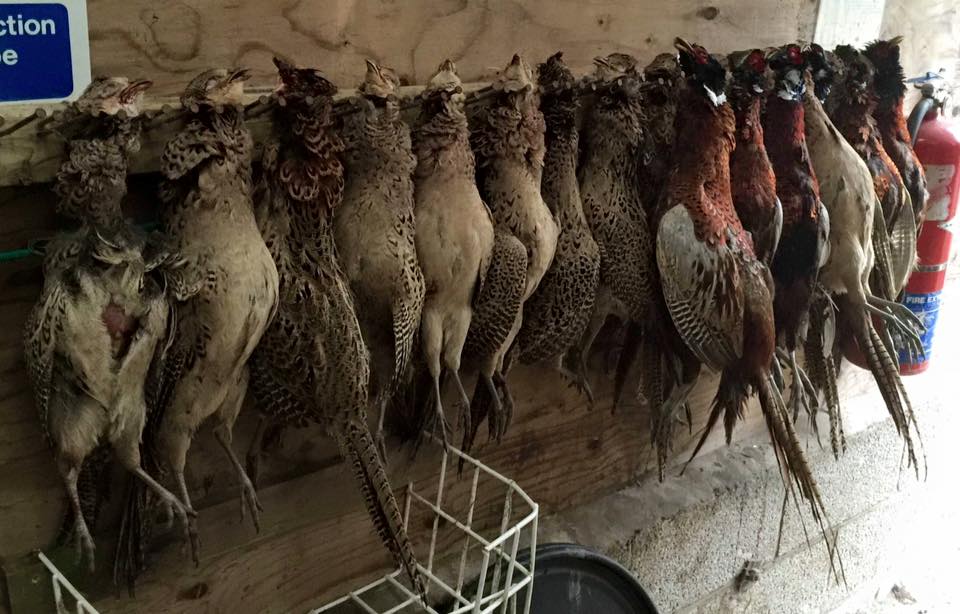
     Back at the shoot barn Tom went through the post shoot ritual of reading off the day's tally. On this day, with 18 guns alternating the shooting, we killed 36 pheasant, and 2 woodcock.


Hanging birds, and a happy beater


     My day wasn't over yet. there were still ducks to be killed, so after a bit of a break, and some minor equipment changes, we made our way to the small pond at the end of the Wetlands drive to wait for the ducks to start coming in. The duck shooting took a very British form, too. Not restricted to daylight shooting hours, we were shooting ducks in the dark. The silhouettes of ducks, coming from behind us in twos and threes would drop quickly into the pond. Then the sky would lighten momentarily with muzzle flash. In most cases the initial shot at the dropping ducks would be a miss, but the follow up shots on the now flaring ducks would cut down at least one, which Roxy the Lab would happily retrieve. Not sure I'd be able to adjust to shooting in the dark, I found that even I could find away to get the muzzles pointed in the right direction, and killed a Mallard. After about an hour of solid darkness, our small team of 5 guns had killed 5 ducks; 2 Mallards, 2 Eurasian Wigeon, and a Teal. And I'd learned that shooting ducks in the dark was both effective and fun. With a full day of shooting behind us, Rick and I cleaned up, and hit the pub (The Pipe and Glass) for an excellent meal, a pint, and a recap of the day.

The evening's duck harvest

     While the shooting was now behind me, the outdoor adventure, and exploration wasn't. As a grouse hunter I've made a bit of a study of the Red Grouse hunting in Britain, and hope to one day shoot Red Grouse either driven grouse from a butt, or behind a good dog. On Sunday Rick and I decided to drive north through the moors hoping to see some Red Grouse. And we sure did see a lot of Red Grouse. In fact we saw 32 Red Grouse, both standing and flying, and a couple of grouse butts. I even had an opportunity to do a little bit of an experiment. I've read a lot that the Red Grouse is the fastest bird in flight, and has the quickest flush. I had to see for myself, finding it hard to believe that anything flushes quicker, or flies faster than a Ruffed Grouse. So when we were presented with a Red Grouse holding close to the road I took the opportunity to wade into the heather and flush it from it's roost. Not wishing to start a Hatfield-MacCoy type of grudge between Ruffie and Red hunters, but there is no way a Red flushed quicker, or flies faster than a Ruffie, though I can see where a Red's low, ground hugging flight could make them tricky to shoot.


The North Yorkshire Moors, and a Red Grouse


     By the time I left Yorkshire for London I couldn't help but think that the UK has some fantastic shooting and, if not for the absence of Ruffed Grouse, might be prefect. Top to bottom I had a excellent trip, and enjoyed the shooting. The atmosphere at the Watton Carrs syndicate was identical to that of my regular grouse camp, and anyone of them would fit in up north perfectly, and vice-verse. Without a doubt I will find a way to go game shooting in Britain again.

An old grouse butt in the moors


Wednesday, September 2, 2015

No Ordinary Challenge; The MacNab

     Sportsmen and women around the globe take to the fields and streams for a variety of reasons. There is a lot of satisfaction in dedicating the time, and commitment needed to meeting the challenge, and bringing home a hard earned meal. In some corners of the world the challenge of taking game is not enough, and a select few of a particularly sporting nature venture out seeking ways to make their time in the outdoors demanding. For some this additional demand is only satisfied by achieving a MacNab.

     The MacNab is a sporting trifecta of sorts. In the UK there is the Highland MacNab, where a person bags a stag, a brace of grouse, and lands a salmon, all on the same day. I've also read accounts of  what is called a Summer MacNab, which involve bagging a Roe buck, a wood pigeon, and landing a sea-run rainbow trout. These sound like fine challenges, indeed. I'd be happy with just a brace of grouse, and doubt my system could handle completing a MacNab.

     Here in New England we too, have a MacNab, but few have heard of it, and even few have completed it. The New England MacNab is shooting a whitetail buck, a brace of ruffed grouse, and landing a brook trout. Unlike the UK where season greatly overlap each other, the chance of ever completing a MacNab in the US is slim; our season only slightly over lap. In most of New England Trout season closes shortly after grouse season opens, and the deer season during that time period usually restricts hunters to archery equipment, not fire arms. Even if you did manage to take your buck, early season grouse hunting is often challenging, grouse heard but not seen through the thick canopy of leaves. Of course some states make it impossible. In Connecticut, for example, there is a robust deer herd, and some fantastic trout waters. I have no doubt that a sportsman could take a buck in the morning, then land a brook trout by lunch, but the grouse would pose a problem. While grouse can be found in Ct the numbers are small enough that the state only allows hunters to take 1 a day. So much for the MacNab.

     There are other challenges, too. In Maine you are recognized if you bag a deer, bear, moose, and a turkey (maybe coyote is included, too) in one season. That is a feat, and requires dedication. As a grouse hunter I enjoy shooting a mixed bag. While I've enjoyed a few heavy game bags in my time I've never had the pleasure of taking grouse, woodcock, and hares all in the same outing. I've had plenty of grouse/woodcock, woodcock/hare, and hare/grouse days, but never the trifecta. And while I always carry a separate supply of non-toxic ammo in the car, ready to switch our if I see ducks sitting in the rivers when driving around, I've yet to have the chance to mix fowl with upland species. Perhaps this will be the year I add an additional species to the game bag. No. Not the same wow factor as the MacNab, but not a bad goal, either.


Thursday, November 20, 2014

Grouse Camp/Season Wrap Up.

     Looking around the various states that offer grouse hunting you'll see that the season is well underway, and many hunters are going full bore. Here is Massachusetts the season closes in just a couple of short weeks, while in neighboring New York it hasn't even reached the halfway point. Where I do most of my hunting up north we're about at the half-way point right now. But I'm done. It's unfortunate, but true. Thankfully my season hasn't ended because of injury to either me of Ginger, but rather as a result of real life. I've simply got/had stuff that needed my full attention. So short and sweet I'd need to make the season, and I think I did a pretty good job at that.

     Early October can be a difficult time to grouse hunt. I prefer to stay home until sometime after the second week of the month, after many of the leaves are down, and I can see to shoot. Being a shortened season for me this year I didn't have the liberty of being able to wait, so I planned a 5 day cast-n-blast early in the month. Regular readers of this blog know how that panned out, but I'll recap. A week before my trip Ginger ended up with an injury meaning she would be sidelined until the third week or so of the season; I'd be grouse hunting without a dog. I could still trout fish, though. Right? Well, that didn't exactly work out either; it rained a lot, so not only were the woods wet, but the rivers were swelled up, too. So my trip took on an different form. I hiked, and explored a lot of territory I had been wanting to see for some time. Of course I took my gun, and the dog along, and I even got to see Ginger retrieve a grouse I'd had the pleasure of flushing along side the trail I was hiking, so it wasn't a bad trip. In fact, it was a pretty good trip, as I made the decision to give Ginger a couple of short runs in some easy cover, and sure enough she did her job, and I did mine, resulting in 6 birds in the bag.

     My regularly scheduled grouse camp was later in the month. Every year BK and I spend a week up north, and this year was no different. Well, it was a little different. I decided that a week wasn't long enough, so I headed up a few days early to make it a 10 day stretch in camp. Also, BK's father Frank joined us in camp for his first ever grouse hunt.  We also got to spend the some time in the woods with Gregor McCluskey of Braeval clothing. As usual the food was splendid, the drink merry, and the company unsurpassed. The hunting was damned good, too, but the shooting,.....well, it's true that I am haunted by some of the easy shots I missed. But what would grouse hunting be without the occasional whiff at a slow pitch? The negative to this season's camp was the weather. It rained a lot. We often found ourselves starting late, or finishing early because of the rain. While it is true that grouse can be hunted in the rain, I don't like to do it. Grouse hunting is supposed to be pleasurable, and being wet and cold in a great north woods grouse covert is anything but. Of course, we did hunt a few days in the rain, because we were left with little choice. Most days, however, we only hunted a few hours between showers, and then enjoyed some good story telling in camp.

     Like all camps there were memorable moment, and Frank getting his first, and second woodcock (on the same hunt, in the same covert) was just one of them. Early, before BK, and Frank got there I had the good fortune to kill 4 birds (1 grouse & 3 WC) in 4 rises, only needing my second barrel on  the grouse flush. That doesn't happen very often and I doubt I'll forget it anytime soon. I also had the pleasure of seeing Gregor's young Red Setter, Laddie, point a grouse; something he's struggling to do like most young pointing dogs. I enjoy watching a young dog come in to his own, and Laddie was fun to watch. BK's Labrador, Ruby, put on a woodcock finding clinic one afternoon that I'll soon not forget, and on the last day, after everyone else had left I made a memorable shot when a woodcock flushed out of an edge, and tried to escape by flying across a clear cut top, and up a cut finger, only to be dropped stone dead at no less than 50 yards. But perhaps the most memorable event was an end of the day redemption walk. It had been one of those days when I just wasn't connecting. Early in the day I'd suffered some terrible shooting, and only had a woodcock to shot for 14 flushes. I hunted the last 2 hour of the day with BK and Frank, and while we were again getting birds in the air, none were coming my way, and BK and Frank were getting all the shooting. As we cut across a clear cut to get out to the road, having called it quits, I decided to walk the edge of the wood line perpendicular to the cut down the hill to a skidder I knew went out to the car where I'd meet them in a few minutes, it only being roughly 150 yards to the skidder and out to the car. What a great 150 yards that turned out to be, and by the time I'd hit the skidder I'd filled my woodcock limit, and killed a grouse. Not only was the edge holding birds, but BK and Frank got shots at woodcock out in the clear cut. It'll be a long time before I forget that short walk.


Returning home, I put away the guns and the hunting clothes, and turned my attention to the real life issues that cut my season short. But not before taking a good look at my notes. My season totals are as follows. Due to the weather I only hunted 22.5 hours. In those 22.5 hours Ginger flushed 163 birds, 87 grouse & 76 woodcock for a flush rate of just over 7 birds per hour. I killed 3 grouse and 15 woodcock, connecting on roughly 11% of the birds flushed. Considering that I (conservatively speaking) only ever get a shot at half of the birds that are flushed I probably connected about 20% of the time. Anyway, however you calculate it, grouse camp was fun, and I'm already looking forward to next year.

 
 4 for 4

Ginger and Ruby

 Ginger taking a break

A special bottle of whisky from Gregor's family cask

Ginger with a brace of woodcock

The 50+ yard woodcock

Wednesday, October 15, 2014

One Season Ends, Another Begins

     Sometimes it all seems to be happening at once, and the beginning of this month was one of those times. GW was off for a week of trout fishing in the Rangeley area, BB was in Arizona on an Elk hunt, and my father, like always, was in a tree stand with his bow. It was a good time to be an outdoorsman, and Ginger and I were up north for an early season cast-n-blast.

     October 5th I pointed the car north, and headed up to my regular haunts to chase some early birds, and trout. In New Hampshire Grouse trout season closes on Columbus day, and Grouse season opens on the 1st, so I thought this would be the year I got after them both. Of course things don't always happen the way we'd like them to, and an emergency room visit, and several suture in the chest, for Ginger meant I'd have to call an audible. My cast-n-blast was renamed, and my trip north was now a 5 day cast-n-scout. No problem. I've had some ideas, and wanted to take a look at a few areas, so taking some time out to do some casual walking would pose no problem. Besides, there isn't much better than taking a nice walk in an area as beautiful as the great north woods.

     The weather didn't cooperate, and I ended up spending a bit more time in camp reading that I'd anticipated, but when the sun was shining I made the most of it. I hit the river twice, and thoroughly enjoyed it despite never landing a fish. I was a bit unprepared for the increased water level, and can only blame myself. None the less, I was fishing in the fall, and my waders didn't leak. In fact, I enjoyed my time on the river so much that I'm planning to make a trip to the Westfield river later this month.

     I learned an interesting, and somewhat disturbing tid-bit about the area. I bumped into a friend, Eddie, who shoot at the same skeet club. Eddie is an older gentleman I've known for some years now, and who I have always known to be humble, down-to-earth, a knowledgeable outdoorsman, and one who is not prone to exaggeration. Eddie swears he saw a wolf, and knowing Eddie, I am prone to believe him. Of course Eddie's wolf tale piqued my interest, so I approached Gary, an accomplished big game hunter, and Owner of Spruce Cone cabins, and inquired about wolves in the area. After a lengthy conversation with Gary it seems that wolves, though widely seen, are not new, having been several times over the last 5 years. And get this; Gary knows of a reliable Mountain Lion sighting, too. But I didn't follow up on that. I will be looking into the wolf issue more in the future.

     The grouse and woodcock hunting proved to be exciting, and if the flush rate I experienced hold it should be a super season. Ginger being on the mend, I only put her on the ground twice, in cover I knew to be easy going, for short runs. We kept it short, and never strayed very far from the car, but I chose correctly; Ginger flushing 41 birds, in about 3 1/2 hours of hunting over 2 days. She put up 15 grouse, and 26 woodcock, of which I killed 6 birds. On day one I killed the only grouse I got a shot at, and a limit of woodcock. On day two I added a brace of woodcock to the mix. I was especially excited to get into good woodcock numbers, as I think they are the tastiest bird out there, and in the last few years I haven't gotten into them like as much as I would have liked to.

     Hopefully our streak continues, and the flush rate stays high. I've come to expect a flush rate of about 4 grouse an hour, with an even better rate in good years, though I will admit that there are time when I have walked for an hour without a flush, before stumbling into a honey hole with 10 flushes in an hour to save the average. I guess we'll just have to wait and see what happens. But we won't be waiting very long; Ginger and I are off for a 10 day stint in grouse camp tomorrow morning. Stay tuned.

Sunday, December 2, 2012

That's A Wrap- 2012 Grouse Camp(s).

     Sometimes it all comes together nicely. Like it has this fall. A young dog, some good friends, and a series of fortunate events meant writing got pushed to the back burner, and hunt moved to the front. And in moving it to the front burner I also turned up the heat, and kept it at a rolling boil for as long as I could. Now, however, I've begin to wrap up my grouse hunting season. It's not over, and I fully expect to spend a few more days in the woods with Ginger, but no more multi-day, no more camps.

     I've been very fortunate this season, and went to 5 grouse camps for about 30 days in camp. With this being Ginger's first season 30 days in grouse camp is immersion learning, and she learned quickly having been given the opportunity to flush a few hundred grouse, a boat load of woodcock, and even a few hares. Naturally I was the week link in the process, my shooting suffering greatly. While I shot a few birds, and hares I should have pocketed double what I brought home. The sting of missing made worse by the fact that many of the misses absolute softball flushes, in the open, with few trees to intercept shot string, or obscure vision. None the less, my shooting percentage was high enough that Ginger was allowed to learn her trade, and begin to excel at it.

     Both Ginger and I learned a lot this season. Ginger about hunting, and grouse behavior, and me about dog training. Ginger learned that the flush of a low flying grouse was much more exciting than the wind up toy like flush of a woodcock, and with that I learned that steadying a young spaniel on grouse wouldn't be as easy as I'd thought it'd be. So again it was off the the races, and back to a little dog training. As fate would have it, a little refresher yard work, and a little whistle work was all it took to her squared away.

     Our travels took us to 2 camps in northern New Hampshire. The first camp with GW which I wrote about last month, and the second, a week long camp with BK and his Lab, Ruby, where we managed to put a dent in the local woodcock population. At one point BK and I found ourselves each with a limit of woodcock in about 30 minutes, and having to round up Ginger to hunt dead for 3 woodcock on the ground at the same time.

     After a brief respite from hunting to attend some required training at work I was ready to go again when November rolled around. First Ginger and I made the long drive to Pennsylvania for our annual grouse camp with the ASO pro staff and some friends. While the area of Pa we hunted wasn't the best grouse cover, with 8 guys, 4 dogs, 3 bottles of whisk(e)y, and a huge fire place in the camp, we still had a great time. This, of course, goes without saying as anytime we get this crew together we have a great time.

     Ginger and I soon found ourselves in the great north woods, thanks to the extreme generosity of some friends who allowed me open door privileges at their camp. It was then that I took a bit of time to do some refresher yard work with Ginger that quickly resulted in having a dog steady on not only woodcock, but ruffed grouse too. The open door policy of the camp gave me nine more days up north, and allowed me the opportunity to enjoy the company of some new people and dogs. More often than not dogs out numbered people in camp, and their variety was stunning. I was able to spoil and tease 3 English Setters, 2 Red Setters, 2 French Brits, 2 English pointers, 1 German Shorthaired Pointer, and a Lab. And as much fun as that was, sharing a beverage with their owners was equally enjoyable.

     Ginger and I will be spending a day in the woods later this week. While we've got good grouse cover within driving distance of the house we know that it will pale in comparison to the camps we've had the pleasure to attend. But we'll make the most of it.

**A special thanks to Tim, Ted, Al, and Russ for letting me take over their grouse camp.

Monday, October 29, 2012

Firsts and Seconds, North Woods Bird Hunting

     The great north woods are a magical place. Well, at least for me they are, though I doubt I'm the only sportsman who feels this way. Whether it's fin, fur, or feather there is game to be had in the great north woods. Its for this reason that I routinely make the long drive several times each season. Couple the great sport of the north with a young dog in need of a quality education, and my desire to go north increases dramatically. This year I had the great fortune of having my vacation from work fall right in the prime of grouse season, so off I went to spend 12 days wingshooting. The first five days would be accompanying G.W. who was headed up to cap off the trout season. Then, after a four day regroup I'd head back again to spend 7 days in camp with B.K. and his lab, Ruby.


     If I was to experience any difficulty on my adventure it was of the nature that warrants no true complaint; traffic slowed my departure from the city. Before too long I was zipping past the multitude of leaf peepers clogging the roads. As the local traffic had put me an hour plus behind schedule I decided I stop and hunt at least one of my coverts near the halfway mark to camp. This would allow me to blow the dust off my reflexes, and serve as Ginger's grouse and woodcock debut. Mid-morning would be the prefect time to slip into the abandoned orchard, and it's surrounds. I did not regret this decision. Ginger quickly found her stride, quartering the thick under brush between the long forgotten trees. Soon she'd catch a scent she found irresistible and launch a woodcock skyward. It wouldn't be until the third flush that the 20gauge side by side would bark loudly, but it wouldn't register a kill, and Ginger would have to wait a bit longer to get her mouth on some feathers. To my surprise Ginger held steady, planting her but on the ground with each flushing bird as we'd trained for, not moving until sent on. We worked the edges, before moving deeper into the cover. A few more birds were flushed, and a couple of misses registered before my eye, hand, and the 20 found the rhythm needed, and knocked down a fleeing timberdoodle. The bird flushed late, pinched between me and the dog, requiring Ginger to be stopped on the whistle, and sent on a hunt dead for her first retrieve, as she'd not marked the fall. Enthusiastically she took the cast and scoured the area until nosing the bird, and looking at me quizzically with a  "You want this?" expression. A moment of coaxing, and the bird was delivered to hand. Five minutes later the scene would be repeated only this time the bird would be flushed on her nose, the fall would be marked, and the retrieve made without hesitation. We would work our way deeper into the linear cover, and then around to our starting point with couple more woodcock flushes, but only a lone, distant grouse flush. With two woodcock in the bag Ginger and I continued our trek north.


     The north woods would provide the action I was looking for, and the education Ginger needed. Woodcock were abundant and provided plenty of sport. Grouse numbers are up too, which presented Ginger with tricky situations. To that end I shot not only Ginger's first woodcock, but her first grouse, too. Ginger's first grouse came in the midst of some heavy woodcock shooting. As Ginger quartered, stretching slightly further to the windward side to my left a grouse was pinched between us. Like her first woodcock the grouse's flight and fall on the shot went unmarked by Ginger, so I whistled her to a stop, and moved her forward to hunt dead. The Grouse, with a broken wing put some distance between us, but wasn't able to avoid a keen nose, and was retrieved nicely to hand.


     Sometimes, however, it's not a young dogs firsts that you remember, and proudly reflect on, but it's second that shows a dog's potential, and willingness to please. Ginger had begun making game on a thick stemmed hillside. I followed her to the edge of the cover where she continued to make game below me even though the cover had thinned and looked more of a likely place to flush a hare, than a grouse. Suddenly the young dog made a quick move to the base one of the few trees spread across the area, and a grouse flushed explosively on her nose presenting me with a left to right slightly quartering away crossing shot. My first shot failed me, but on my second shot the grouse dropped from the sky, and landed somewhere out of sight over the edge of a slight drop off. My attention then turned back to the young dog, who was sitting staunchly at the base of the tree the flush produced from, casting glances from me, to the mark, and back again. I walked towards the mark about 5 yards until I could see the area of the fall, then released Ginger on her name. She raced to the mark, where she ran a couple of quick, tight, high speed circles before picking the grouse from the underbrush and presenting it to me. My little girl had flushed a grouse on her nose, stayed steady throughout the entire flush, shot, and fall, marked the fall, and retrieved to hand as if she'd been doing it for years. I couldn't have been more proud. I'd learn later that not all birds would be handled as nicely, but  we were off to a great start.


     Woodcock would rule the day on my second trip to the great north woods. B.K. and I would find out quickly  a number of woodcock could test a young dog, as well as multiple tricky grouse flushes could.  For the most part Ginger's manners stayed intact thanks to the woodcock's nature of flushing skyward. Grouse were becoming a problem, as their tendency to flush horizontally before gaining altitude was too tempting for Ginger, on may occasion requiring me to steady her with the whistle. Thankfully through it all she still remembered what a long blast on the whistle meant, and heeded the signal.

     On our second or maybe our third day in camp B.K. and I made a quick trip through one of our usual spots with Ginger. Right out of the gate we moved a couple of woodcock, and a grouse, but none were put in the bag. An hour in and things had slowed until we wandered into a cut thick with head high alders, and B.K. secured a woodcock. We'd moved barely 20 more yards and suddenly all hell broke loose. Ginger flushed (and failed to stop on) a woodcock that I rocked on the shot. Not being well hit, nor marked by my now out of control dog, I stood still and directed B.K. to the area of the mark so we could then reign Ginger in and have her hunt dead. We were soon to understand Ginger's unbridled excitement.

     As B.K. reached the area of the fall another woodcock got up, but it's straight away flight line was no problem for B.K. who easily stoned it. With two down, and a seemingly unhinged spaniel I would surely be needed at the area of the fall to regain control of the dog and recover our game, however on my first step in that direction another woodcock flushed at my feet offering a straightaway in the opposite direction, and I killed it easily. Now with three birds on the ground and who knows how many holding around us, it was time to get busy, and I whistled Ginger in to hunt dead.

     We elected to recover the last bird I'd killed first, as B.K. was already in the area of the other two. Ginger, now in control made short work of this bird, and we turned our attention to the other two. Working the area B.K. had marked Ginger began to make game slightly off the mark, and after a minute or two presented us with a winged woodcock. At this point I'd begun to think that I'd actually missed the first bird, and that the one B.K. had shot was a reflush of that bird, and that was what Ginger had just retrieved. But B.K. insisted that he'd clean killed his bird, and that the winged bird had to be the one I'd shot. So off Ginger was sent to find yet another bird. The search wouldn't last long as B.K. quickly notice that the dead woodcock was laying a mere 6 inched in front of his right foot as we stood there watching the dog. We now had 4 woodcock in the collective game bag. And while it took me a good few minutes to recount this story, and you a bit less time to read it, in real time it all happened real quick, with all three shots happening withing 60 seconds, and the recovery of the birds taking only a couple of minutes.


     We weren't done. With Ginger reeled in we moved forward and killed two more well handled woodcock within 50 yards of where we'd picked the last three. Two limits of woodcock were killed and in the bag in about 20 minute of what was a 2 hour hunt. That many birds, that much scent, and that much shooting in such a small area did present a problem for the young dog, but nothing that couldn't be recovered from.

     Throughout the week many woodcock were shot and retrieved by B.K. and I, as well as some grouse. Both dogs saw their fair share of birds, and time in the woods. Ginger and I both learned a lot about grouse and woodcock hunting, and what is expected. An additional highlight of my second trip north was sharing camp with a contingent of spaniel people. In total there were 19 springer spaniels spread between three cabins and an RV. It made for some interesting, enjoyable, and educational conversation. I was relieved to hear that I wasn't the only spaniel owner having difficulty with steadiness in a young dog when dealing with the excitement of a grouse's horizontal flush. In my opinion one of the most exciting thing in the grouse woods is when a dog flushes a grouse back at you, and several times Ginger did just that.

     Life being what it is B.K. had to depart camp early because of a business trip he was required to make. On his last morning before heading south he and Ruby went out on a solo trip while Ginger and I explored a covert we hadn't touched yet. We returned to camp to find that Ruby had guided B.K. to another limit of woodcock. A nice way to part.


     We did some things differently this year. Gone are the days of feeling the need to beat the brush all day long. Instead we hunted from about 9am to about noon, enjoyed a leisurely lunch, then got out again late in the day, hunting the last hour or two. This tactic showed us lots of grouse, however most often they were flushing from trees. Still, having multiple flushes, 10-11 grouse from two trees, is quite exciting.

     Reflecting on the trips later I easily knew what I need to work on, and what the successes were. Like always my shooting proved to be a weak link, and birds that should have fallen flew on. The weather didn't cooperate, but over the years we've learned what we can handle and how to deal with rain. So we made the best of the opportunities we had, and had the right equipment for the times it was needed. Ginger was a success, too. Though there were moments when her youth, and excitement got the better of her, the work I've put into her was apparent. All in all I give her performance a B+, improving as her steadiness improves.