Wednesday, September 4, 2019

Grouse School 2019/ Boston/South Shore RGS Chapter News

     Once again, Grouse School was a success. On August 18th I held another Grouse school event for the Ruffed Grouse Society. This year the event was held at the Mass Fisheries and Wildlife Headquarters in Westborough, Mass. The grouse school is designed to give put n take pheasant hunters baseline info to allow them to expand their sport in to the woods and after wild birds. Roughly half of the 22 attendees were exactly the demographic the program was designed for.

     Like the last Grouse School RGS regional biologist Andy Weik discussed habitat, and where to find grouse. Mass small game biologist Dave Scarpitti talked about public lands in Mass, and the state of grouse and woodcock in Mass. Both Andy and myself talked about scouting, and Andy's presentation on how to use Google Earth to scout was as popular as ever.

     After lunch I did a presentation about dogs and dog training, but unlike the last event, we did not do a dog demonstration due to the heat. Boston/South Shore RGS chapter president Ernie Foster did a nice presentation about guns and shooting followed by RGS regional director Joe Levesque's discussion of equipment. We concluded the event with about 45 minutes of tactics and Q & A. I was happy with the way the event turned out, and we all received good feed back. The event went so well, that rather than alternating between Grouse School and the shooting clinic every other year, I am going to scrap the shooting clinic, and hold Grouse School every year.

     Continuing,...

     After the Grouse School concluded I decided it was time to get involved with the local RGS chapter. Until now I had been operating as a RGS Nomad, but I have been impressed with the level of  commitment the members of the local chapter have shown. So, I tossed my hat in that ring.

     That brings me to the next issue. We are having a "banquet".  Not a traditional banquet, but rather a good old fashioned party. The event is called A Night For Conservation, and all hunters and anglers are welcomed. We are intent on cross pollinating with other conservation groups, such as Pheasants Forever, WTF, and TU. Our missions overlap, and by understand each other, and when needed, working together, we are that much stronger.


     I've also got another campaign I'm beginning to work on. I think it's time to call it like it is, and stop being polite to those who would hurt us. In particular the anti-timber cutting crowd. We need to start calling them what they are; anti-forest management. While they "care" about the forest, they clearly don't care about the animals living in it, especially the 388 species of vertebrates that have a dependency on early successional habitat. Without proper forest management and timber cutting no new early successional habitat is created, and existing habitat becomes mature and no longer provides for the species that depend on it. I've begun working on a fact sheet that address this very issue. 

Prototype of fact sheet. Still under construction.


Monday, August 19, 2019

You Want To Hear a Secret?

     You want to hear a secret? I have uncovered the secret to successful wingshooting. Really, I have. Do you want to shoot more grouse, or pheasant, or ducks, or whatever, this fall? I know I do. So how is that done? Was is the secret? Well it's been staring you right in the face for a long time, and it's a pretty easy solution, really. Practice. Yup, that's right. Practice. Get out your trusty shotgun and practice.

     To be fair, it's not quite as simple as just going to a club and shooting some skeet or trap, but it's not that far off. The key is to practice like you play. Wingshooting in wolves quite a lot of dynamic, coordinated movements. A simple round of regulation skeet or trap will help to some extent, but lacks most of the additional movements that must be coordinated. So how does one add a bit of dynamics to their clay shooting? Like I said, practice like you play. Do you walk in to a bird flush, or sit is a duck blind with the gun up and in your shoulder, ready to swing? I'll bet you do not. So start shooting your clays with a low gun and implement your gun mount in to your practice. Try to develop a smooth gun mount with as little extra movement as possible, but one where you incorporate your swing (left-right movement), in to vertical movement of lifting the gun into your shoulder.


     Once you've established a gun mount you can begin to incorporate it in to your clay shooting to make it more dynamic, but it doesn't stop there. Oh no. This is just the beginning. Here are a few of my favorite ways to make skeet more dynamic, and help you prepare for the bird hunting season. 

Delayed Pull. This is where you have the trapper (the guy pushing the button to send the clay) delay the pull anywhere from 1-5 (or more) seconds after you call for the clay. 

Trapper's Choice. Similar to delayed pull, but the trapper gets to decide whether to send the high house first or the low house, surprising you even more.

Doubles. Shoot doubles on all stations, taking your second pair on stations 1, 2, 6, and 7 backwards. 

Remember, you are shooting every station, including station 8, with a low gun.

     I prefer skeet to trap, but if you only have a trap field on which you can practice there are ways you can make trap more dynamic too. Delayed pull works on a trap field, too. Where permissible, stand directly behind the trap house, and have someone surprise you with the pulls. If possible, cranking the spring arm up to doubles speed will send the clays even faster, and if your trap field is equipped with wobble traps, then that is another option. Again, always practice low gun.

     Practicing like you play isn't just about shooting low gun. It is also about using the same equipment. No more dedicated clay target guns, use your field guns. Use the same choke combination you would in the field, too. Many clubs have restrictions on shot size, but if you can use the same size shot, or even the same ammo you hunt with. Do these things and you will see improved success afield this fall.

** A quick word for those who always find a way to criticize clay shooting, and claim there is no relation to wingshooting. I often hear people come up with some reason clay shooting is no good as practice. You are wrong. If you don't enjoy clay shooting just say it. Nothing wrong with that, but to say that improving the relationship between your eyes, hands, and brain does not improve ones wingshooting is just stupid. 


Monday, August 12, 2019

The Awakening

     The Awakening has commenced. No, I am not referring to any horror movie type scenario. I am referring to all the clues around us that grouse season will soon be here.

      Some of the clues are quite apparent. Today as I browsed Facebook I was inundated with post after post of people celebrating "The Glorious 12th", which marks opening day of grouse season in the UK.  I enjoy reading about moorland outings, and one day will have my own tale of tweed and heather to tell. Just not this year.

     Other clues are less apparent, sneaking up on us, and upsetting the household balance. Like every year, the first cool, dry August nights signal a change in behavior and thoughts of the upcoming grouse season start occupying our cerebral space. Like an Autumn moon affects the woodcock, the changing night air affects the wingshooter. None more than the grouse hunter, who begins straining in an effort to spot the first hint of leaves changing color.

     I am affected no less than anyone else, maybe more. In the week alone an obvious change has occurred. Equipment which has been stored since last winter has once again seen the light of day as it is inspected. Boots have suddenly found a new coat of boot oil, and plans to sit at the reloading bench, building the perfect grouse load have been laid. The change has not been lost on my very lovely and supportive wife, who upon returning from work in the evening does not make mention of the fact that I am watching the same Ruffed Grouse Society YouTube video for the 15th time. She knows, through experience, how this pre-season build up works. It benefits her, too. She often refers to herself as a hunting season widow, acknowledgement that I do in fact spend a lot of time away from home when grouse season is open.

     This year the build up is probably a bit more intense as I've organized another Grouse School event for the Ruffed Grouse Society. The event is a one day clinic in which we pass on everything the new hunter will need to know to start grouse hunting.

     Of course real life isn't about just grouse hunting, and I've have got a couple other fantastic things in the works to distract me. Next month we will be going back to Japan to visit family. I most certainly look forward to this. We have tentative plans to do some hiking when we are there, and I was informed last night that there is a place I can go fishing, with equipment rental, near where we are staying......but hiking and fishing are not the things I am most looking forward to (after seeing family, of course). The things about this trip that are providing the most distractions from the season build up are my tattoo appointment, and rugby. For some time now I have been in the process of getting a traditional Japanese full back tattoo from Horiyoshi III. This trip I will be having the final installment of what has been a long, interesting adventure. This trip to Japan also corresponds with the Rugby World Cup, which Japan is hosting. I've long been a rugby supporter, and was thrilled to be able to get a ticket to see Wales v Australia in Tokyo. Two dreams coming true in one trip to Japan.

 .......but still, I can't stop thinking about the fact that I will miss the opening day of woodcock season here at home.


Monday, July 8, 2019

Grouse School 2019

     You may have noticed I haven't posted in a while. It's not that I haven't wanted to, but real life has just been getting in the way. One thing "real life' hasn't stopped me from is organizing another "Grouse School" program for the Ruffed Grouse Society. The program is geared towards new and novice hunters who wish learn what it takes to hunt ruffed grouse or improve their success afield. If you live in New England and want to learn about grouse hunting, or know some one who does, come on down.


Thursday, May 9, 2019

Back To Basics; Shotguns

 This blog is a collection of my experiences and thoughts. From time to time I will express an opinion which many will not agree with. These opinions have formed as a result of spending lots of time afield and shooting. These thoughts and opinions are not meant to offend, nor to be judgmental,  but rather to promote more thought on the subject. If for whatever reason you feel my post is directed at you, it is not; I don't know you. This post is part 4 of several (don't know how many yet) on the subject of wingshooting which some will object to. Fair warning.

     Have you ever really thought about how a shotgun works? I'm not talking about triggers, ejectors, and actions, but about how they impact a target. Truth is, how a shotgun impacts a target depends on which end of it you hold when you swing it, because shotguns don't impact a target. The pellets propelled out of the muzzle do, and that is where a lot of the "misunderstanding" about shotguns, and their effectiveness stem from. Shotgun shells are what defines how a shotgun will perform on a given target. Let's look at a common "misunderstanding" (and pet peeve of mine), and try to clear some thing up.


  •      Gauge has no relation to power-  Too many people, some of whom have been shooting for a long time, think that a shotgun's gauge somehow relates to the amount of power it has. It does not. A 12 gauge shotgun is not anymore powerful than any of the sub gauges. Why not? As explained in the paragraph above, shotguns do not impact a target. What you put in to them does. The shotgun is just the means of delivery. The components, and make up of the ammo you choose is what bears the "power". 
  •      Gauge has no relation to range- Range is a function of a combination of pellet size (weight) and velocity. You can read about it here.  https://allseasonsoutdoors.blogspot.com/2019/01/the-science-redefined.html
  •      The ammo dictates the "power"-Take a standard ammo load, for example, 1 oz of #6 (222 pellets) propelled at 1200 fps. This load will carry the same amount of energy (power) whether propelled out of a 10g, 12g 16g, 20g, or 28g. Which ever gauge you choose, this load has the same efficiency, when all the other variable remain the same. 
  •      Don't use flawed logic- I know what you're thinking,"My 12gauge 1 1/8oz #5's @ 1250fps are more powerful" Yes. They are more powerful than the first load, but that's not because they are a 12 gauge load. It's because it's a bigger load, and a faster load. If you packed 1 1/8oz of #5's @ 1250 fps in to a 16g, or a 20g hull they would have the same "power" as you're 12 gauge. If you're not comparing equal variables, then you are using flawed logic. 


     What are some of the advantages of a 10g, 12g, or even a 16g?


  •      Room for more pellets- Having a larger bore diameter means that more pellets can be fit in a shotgun shell. When shooting loads with smaller sized pellets often a load as light as 3/4 oz allows for a pattern with enough density to efficiently hit any target. When shooting larger pellets, going to a larger payload increases your pellet count and pattern density. Where  a pheasant hunter may have adequate pattern density of 222 pellets shooting 1 oz of #6's, a waterfowler may appreciate having better pellet density than the 87 pellets in a 1 oz load of #2's. In that case one could choose to shoot a magnum 1 1/2oz load with 130 pellets. This is not an increase in power. 
  •      More pattern density- unlike the example above where one goes to a larger payload to increase the pellet count of larger pellets, sometimes your target may leave you wanting more smaller pellets. I do not shoot competitive clays, but if I did I would do so with a 12 gauge. Why? A clay target is a smaller target, and often shot edge on. This means a clay target can more easily slip through any holes in a pattern. To remedy this one can increase the density of their pattern by increasing their pellet count from 356 pellets (7/8 oz #8's) to 508 pellets (1 1/4 oz #8's). This is not an increase in power. 
  •      Convenience- One will never have to look very far to find 12 gauge ammo. If you travel to shoot, either clays or in the field, sooner or later you will need to buy ammo while on the road. Not only will you find ammo, you'll probably find ammo you like. There is an abundance of 20 gauge ammo available, and I've never struggled to find some, but there have been times when I've had to shoot #6's when I'd have preferred #7 1/2's. This is where the popularity of the 12g becomes an off brand benefit. This benefit, however, does not transfer to 10g, or16g ammo, both of which can be quite difficult to find.

      So why would anyone choose to shoot a 12 gauge (or any other gauge)? It comes down to choosing a gauge and a gun that best meets your need.  I tend to break gauge down in to two categories; large bore and sub-gauge. I define large bore as 10g, 12g and 16g, and sub-gauge as 20g, 28g, and .410. Many 16 gauge shooters consider it a sub-gauge, but in my mind it's a large bore gun even though it is marginally closer in size to a 20g than it is to a 12g.  Each category has it's own pros and cons. I shoot a 20 gauge almost exclusively. It works for 90% of my shooting needs. That said, there are a couple of situations where a 12 gauge would actually provide an advantage.


Friday, May 3, 2019

Paying It Forward; Savage Service Program

     Sometimes a little recognition is a nice thing. As someone who has spent nearly his entire adult life working in the public safety arena (4 years USCG, and 23 years career fire dept), the recognition and appreciation go a long way in helping to make it feel like a worthwhile venture during the times when you start questioning your judgement. Of course, those times when you do receive a bit of recognition and appreciation aren't why we do it, and I doubt I could explain why we do, but take it from me, it isn't always easy, so....

     Anyway, a while back I became aware of a program Savage Arms is running that recognizes, and shows some appreciation to those in public service. The Savage Service Program is a program where police, firefighters, EMTs, Military members, Veterans, Retired Military, and other in service can purchase a firearm from Savage at a 30% discount. There are restrictions as to who qualifies, and how many firearms per year can be purchased, so read the fine print closely. You will also need an FFL holder to receive the firearm for you, as is required by law.


     To find out if you qualify, or to purchase a firearm go to https://www.savagearms.com, and scroll to the bottom of the page. Under Resources click the Service Program link. This is where you can find out if you qualify.  Then at the bottom of the page click DOWNLOAD THE SERVICE PROGRAM FORM. This is the form you use to order your firearm. Savage may or may not have what you are looking for, but they do have a pretty broad selection of rifles and even a few shotguns.


Sunday, April 28, 2019

Fit For A King.

     Ruffed grouse are a tough bird, living in tough conditions and tough habitat. No doubt hunting them is tough, too. Truth be told, it's the fact that the Ruffed Grouse is a) excluding Woodcock, the only wild upland bird in New England, and b) tough to hunt, my main attraction to hunting them. This means one would be wise to get themselves and their dogs in shape prior to the opening day of the season.

     Fitness is an area where I have fallen by the wayside. Not too long ago I actively kept my self in shape to the point where even at 50 years old, a couple of weekends each spring and fall I made my way on to the rugby pitch for a bit of a throw down. But the last couple of years I haven't made any effort to be/stay fit, nor get back in shape. A few years ago I suffered a wrist injury, and after a year of not working, a surgery which left me with a partially fused wrist, and months of physical therapy, I finally had a wrist that was good enough for me to go back to work. This doesn't mean I was without my troubles. I lost a lot of mobility and strength in my wrist. 

Even as an old-boy I could leave a trail of destruction. Will it happen again?


     My lack of mobility left me unable to correctly hold and mount a shotgun. To get past this issue I installed a soft rubber palm swell on all my pistol grip stocked shotguns, which allow me to get the gun in to my shoulder correctly while filling the void between my palm and the stock caused by the lack of wrist mobility. Straight stocked guns, being shaped somewhat differently require the use of a Gripswell glove. Anyway, my wrist issues have been floating around in the back of my head for some time, and I've been scared to get in the gym, or out on a bike in fear of aggravating my wrist. Time to put that behind me and start getting back at it again.

     There are two kinds of outdoor grouse related exercise; exercise for man, and exercise for dog. The two do not really go hand in hand very well in many cases. This year I have decided to make a serious effort to increase my fitness level in a few different ways. Let's look at what I plan to do and why.

  • Hiking- I live very close to the Blue Hills Reservation in Massachusetts. This reservation has hundreds of miles of trails, some quite challenging, I can hike. I enjoy hiking, and think the endurance aspect of a long, tough hike on a regular basis will be beneficial when grouse season opens. In addition, I can bring the dogs along. While the dogs will certainly enjoy the hike, it is not very strenuous for them, and wouldn't be my first pick for getting them ready for the season.

  • Mountain Biking- This is my plan to get more serious cardio going. Mountain biking is fun, and a few good hill climbs is a great way to increase the heart rate. This, too, can include the dogs, but one would need to select the right location and, understand the limits of their dogs. In the past I routinely roaded Ginger from a mountain bike to get her in top shape. We had two different routes we could take, a 4 mile course, or a 5 mile course. Both courses were relatively flat, and offered numerous places along the way where she could get a drink of water, or cool off with a quick dip. Roading Ginger, however, was not an activity where I got lots of exercise. A 4 or 5 mile run for a Springer is a decent run for the dog, but not anywhere nearly enough cycling for a human to get a good workout. Sure, I got some benefit from it, but as a stand alone, it isn't enough, so there will be two different types of mountain biking happening; for me, and for them. No doubt a bigger, leggy pointing dog could run more than 4-5 miles, getting both of you a workout. Depending on the breed of dog you hunt with, mountain biking may be the thing.

  • Yoga- Well, not really, but I may give it a try sometime soon. I have, however, begun a comprehensive stretching routine. Stretching helps keep the blood flowing, and I just feel better when I do it. Truth is, I am not very limber, so this stretching came out of necessity, but as I see and feel progress, I really do feel better. I can't help but think being more limber will help to swing a shotgun better, too. Shoot better? Hmmm,....Maybe I will give yoga a try. 

      Hopefully this plan will pay off when grouse season opens, and I find myself following various spaniels across the New England uplands. In the past I used Apps like Runkeeper and Strava to track my workouts. I may start doing that again, and posting my workouts on the ASO Facebook page to keep myself accountable. Who knows? Maybe I'll even find my way on to a rugby pitch again.


Monday, April 22, 2019

Tradition and Hogwash, The Truth About Grouse Hunting

     Ruffed Grouse hunting ain't easy. If it was everyone would do it. The same challenges that keep people out of the grouse woods is what draws me in to them. In my quest to become a better grouse hunter I have constantly worked at learning my craft. Be it field craft, shooting, dog handling and training, or game handling there is a lot to learn. So why would people try to make being a grouse hunter even harder?

     One pervasive sentiment that is often spread through the grouse hunting community is the idea of the "traditional" grouse hunter. The idea being that because some of New England's most prolific outdoor writer hunted with an American made side by side, and a big headed, heavily marked, Belton English setter dictates that the tradition demand that it always must be so, and anyone who would break from the "tradition" is less of a grouse hunter. That's hogwash. Then, like now, those most entrenched in an activity used the most efficient equipment available. At one time certain side by sides were the most advance gun on the market. That's why they found their way in to the lives of those who paved the way. No doubt, if the grouse writers of the past were here today they'd just as likely be shooting a well balanced over and under with screw in chokes, ....because technology.

     Why is this an issue? At a time when we should be recruiting new blood in to our sport the last thing we need is arbitrary benchmarks making it harder for them. People shouldn't be told they need to shoot a SxS to fit in, they should be being told they should be shooting a gun that fits them properly so they enjoy better success afield. People shouldn't be being told they need an English setter to fit in, they should be being told they need a well bred dog that fits their lifestyle so they enjoy better success afield.  The guns, dogs, and various bits of kit that go afield are not one size fits all. The truth is, all one needs to be a successful grouse hunter is a gun that fits, and comfortable boots. So whether you shoot pump gun because it fits you well, or a SxS because one of your literary heroes did, shoot what you want. And, whether you shoot over a spaniel because everything is better with spaniels (Okay, a wee bit of bias), or an English Setter because one of your literary heroes did, shoot over which ever breed of dog you want. All that matters is that we all enjoy our time afield.

Less than "traditional" gun and dog getting it done.


Friday, April 19, 2019

Prep'n

     This year's grouse season has started a little early. Well, not really, but it kinda seems like it has. For some reason grouse season has come to dominate my thoughts much earlier than usual. Most years I manage to make it through winter, spring, and most of summer not really thinking of grouse season until the first cool, dry nights roll in mid-August. Perhaps this is because I am doing a number of things differently this year.

     One of the things I'm doing differently is taking a new friend, and grouse hunting newbie, out grouse hunting. Last year I met KK shooting skeet at the club. we started talking hunting, and while I am quite particular about who I will take out to the woods, KK checked all the right boxes, so we started planning his education.We decided that the best way for him to learn about the grouse woods was to get him looking for grouse cover. So we met early one morning last week and drove 2 hours out to the western part of the state to scout. I already had done some long range recon, and had sat down with KK and explained how I use technology to pre-scout, and what I look for. All we needed to do was make some boot tracks in the potential cover to see if it was what we were looking for. It certainly was what we were looking for. Scouting in the early spring, before everything turns green, allowed us to see the cover in very much the same way it will look in the fall. Many of the preferred food sources had not grown back, but there was just enough green starting to break through that we know the grouse will be in there in due course. I tried to make the scouting trip as educational as I could for KK so he'd have an idea of what to look for in the future. We has a very successful scouting trip. I had marked 5 potential areas to check, and all 5 proved to be worthy of visit in the fall. In addition, due to an un-passable road, and subsequent detour, we added a 6th spot to the list.

     Another change to this season, which could potentially be the cause of my early onset of grouse season induced mania could be a planned trip to Down East Maine. I have been wanting to make a return to Maine but just never made it happen. I'd been talking to BK about us spending a week Down East, and we'd tentatively planned to go, but hadn't actually put it on the calendar. Well, it's happening this year, and we booked a week in October that generally corresponds with the woodcock migration. I'm really looking forward to the vast amount of flat cover Down East offers. I doubt this will amount to a leg cramp free grouse hunting vacation, but it'll certainly be less painful than the leg cramps brought on in hilly Coos county.

     I should add, I've recently been sucked down a worm hole called "reloading". A while back I was given a 20 gauge shotshell reloading press. It's been a great new hobby/obsession. I shoot a lot of clay targets, going through in the neighborhood of 1- 1 1/2 cases of ammo each week. Reloading makes sense.It also allows me to load premium ammo. Regular readers will know that I am a huge proponent of shooting ammo that uses a fibre wad. Spreading plastic wads across the landscape is littering. Fibre wads biodegrade, quickly absorbed back into the landscape. Reloading not only allows me to load fibre wads, it allows me to tailor my ammo to my needs. Currently I am loading, in preparation for the season, 2 different loads; a 2 1/2" 3/4 oz load of #7 1/2's, and a 2 3/4" 7/8 oz load of nickel plated #7's. I'm not entirely sure of what I'll use the 2 1/2" shells for, but I think the 2 3/4" #7's will be the perfect grouse load. For the few times that I am grouse hunting near wetter areas where I my also jump a duck or two (don't laugh, it's happened) I will be loading some bismuth, too.

Reloaded to my exact specifications


     There is also a new gun on order, which should be in my hands as early tomorrow. A promotion at work, and securing a new contract put me in a good place, and finding a really, really good deal on a gun I'd been lusting after for a few years meant it was time to spend some money. But I can't really tell you all about it, now. You'll just have to wait.


Thursday, February 14, 2019

Best Bits, Best Kit

     Over the years I've collected lots and lots of shooting and outdoor gear. Some of it good, some not so good. With in this collection there is some bit of kit which, while maybe seemingly inconsequential bring an even greater joy, like the feeling one gets finding a pearl in an oyster, or putting a new pair of wiper blades on the car. I want to share with you a few items which I regard as some of the best kit I own.

     Some time ago Boyt made a soft sided double gun slip. As it was unusual for me to only ever travel with just one shotgun, when seeing one for sale on Ebay, I snapped it up. This may be the number one best piece of shooting kit I ever bought. Boys has a great reputation for well made gear, and this gun slip upholds that reputation.

Looking just like a normal slip, this slip is divided down the middle with flaps on both sides.

     Another item I seldom leave behind is a fleece Beretta shooting vest. Another item which is sadly discontinued, and scored off Ebay. This fleece vest is warm, comfortable, and has bellow pockets for shells. It is, unlike so many fleece vests offered here in the US, actually made for shooting. 

Being overstock sold on Ebay this vest was embroidered with a club name, which I easily fixed by slapping a RGS patch over it. 


     This next bit of fit is not something you take afield, but something you really appreciate afterwards, and that is a Peet boot dryer. I'm not really sure how I managed without one before. I always bring my boot dryer to camp, where it often pulls double duty. Sweaty boots go on the dryer for a bit if at camp for lunch, and then again after the day is over. On cold mornings, much like warming up the car, the boots go on the dryer for 15 minutes before heading out. If you don't have a Peet's you will never miss it, but once you've experienced it, you won't be able to do without.

A small luxury you'll never want to live without.


Sunday, January 20, 2019

Another Look,...At Choke

 This blog is a collection of my experiences and thoughts. From time to time I will express an opinion which many will not agree with. These opinions have formed as a result of spending lots of time afield and shooting. These thoughts and opinions are not meant to offend, nor to be judgmental,  but rather to promote more thought on the subject. If for whatever reason you feel my post is directed at you, it is not; I don't know you. This post is part 3 of several (don't know how many yet) on the subject of wingshooting which some will object to. Fair warning.

     In my last post we looked at choke in relation to range and effectiveness. Now I'd like to address choke from another aspect, and that is pattern size. Often I hear people, generally new hunters,  equate choke to the size of the pattern down range; an open choke shoots a larger pattern, a tighter choke thrown a smaller pattern. This is true, but only in the most basis sense. The reality is, it's not that simple.


     I think part of this results from people not understanding how a shotgun pattern is distributed. If a choke were to throw an evenly spaced pattern over the entire height and width of its pattern, then it would be true that the more open the choke the larger the pattern. A choke does not throw a uniformed pattern however, rather it has a compact core, with sporadic, widely spaced pellets further from the core. Remember, choke is a measured by the percentage of pellets inside a 30" circle at 40 yards. It is the inside the 30" circle part that matters the most. The core of a shot pattern is essentially the size of a road racing bicycle tire. I like to think of choke like the spokes on a bicycle wheel: closer to the hub, the spokes are closer to each other. The further from the hub, the more space between spokes. If the spokes extended outward past the tire the space between them would be even greater.


    Let's relate this to a shot pattern, in generalities of course. I believe the only portion of a pattern one should consider is the 30" core. I consider pellets outside the 30" circle, the spokes extended past the tire,  to be "lucky pellets", though depending on the choke and the range, some are luckier than others. 

     I have begun to look at choke, and decide which choke to shoot based on what I call a sliding scale of degradation. It works on the very basic principle that a given choke, throws a given pattern, at a given range, and after that range the pattern begins to degrade and become less efficient. Any choke will lose roughly 10% of it's core pattern every 5 yards it travels under 50 yards. I decide what is an acceptable amount of pattern degradation within the ranges I expect to shoot, and hope to put appropriately dense 30" circle where it belongs. 


     A few personal note as a follow up; My shooting is primarily done with a 20g O/U. I shoot lots of skeet, low gun only. I hunt primarily Ruffed Grouse and Woodcock, but occasionally driven Pheasant, Partridge, Woodcock, and ducks. Once in a while I hunt waterfowl. It is rare that I am not using a skeet and a Lt Modified choke, either hunting or shooting clays, but I/C and Mod have found their way in to my gun when conditions have warranted, and I'd even use Lt. Mod and Imp. Mod if I felt it were appropriate. 

Friday, January 4, 2019

The Science Redefined

     This blog is a collection of my experiences and thoughts. From time to time I will express an opinion which many will not agree with. These opinions have formed as a result of spending lots of time afield and shooting. These thoughts and opinions are not meant to offend, nor to be judgmental,  but rather to promote more thought on the subject. If for whatever reason you feel my post is directed at you, it is not; I don't know you. This post is part 2 of several (don't know how many yet) on the subject of wingshooting which some will object to. Fair warning.


     Choke selection, Part 1, Range
     Shotgun sports and wingshooting are unique in that they are both a science and an art. To perfect your art of shooting a shotgun, you need to understand the science that makes it possible. Unfortunately, over the years I have discovered that many bird hunters don't understand even the basics of the science. Some of the science is quite basic, and easy to understand, some of it not so much. None of it is terribly difficult to understand, though it may at time be hard to express. One such area often misunderstood is choke.

     Often discussions of choke begin with a question of which choke is needed to break/hit a particular target, often because the target is far. The conversation revolves around a series of choke/range theories. But is choke really where the conversation should start? My good friend John, with whom I shoot a lot of clays phrased it best when he said often the discussion starts at the wrong starting point, and I agree. The conversation should start with what we want to do; break/hit a particular target, and what is needed to do that. So what breaks/hits a target? Choke? No, pellets. What causes the clay to break, or the bird to be killed? Pellets carrying sufficient energy.  That's right. To break a clay or kill a bird you must hit it with pellets carrying enough down range energy.  That means you must pick the right ammo, with a pellet size capable of doing the job. As far as science goes, this is basic physics.

     So where does choke fit into this discussion?  First we need to understand what choke is, and what choke does and does not do. Choke is a measurement of a pattern density. It is defined by the percentage of pellets in a 30" circle at 40 yards. All choke is measured at 40 yards. Why is this important? Because it is an indication of what choke doesn't do, and that extend your range. Many people think choke extends your range.  Range is  determined by a combination of pellet size/density and the speed at which they are propelled. A clay can be broken and a bird killed using any choke provided the pellets are carrying sufficient energy. What choke does, is help you shoot at greater distances more effectively, by making your pattern more dense. By default your effective range is increased because your pattern stays intact, without blowing apart for a greater distance, but ultimately it is the energy in the pellets that achieves the end result.

     Choke, being a measurement of pattern density means one needs to decide what is an appropriate density for the game at hand. I have killed woodcock at over 50 yards, ducks over head at 50 yards, and driven pheasant over head at about 40 yards with  Skeet and I/C chokes. In every case the ammo I selected had pellets which carried appropriate energy at those ranges, and the choke provided enough density to put enough pellets in to the target. The woodcock, and duck may have been pushing the limit of the pattern density, but when considering a pheasant size target skeet and I/C chokes are appropriate for a 40 yard shot. Target size plays as important a role as distance. Many waterfowlers and pheasant hunters choose tighter chokes, because they are shooting longer distances, however all patterns deteriorate quickly past 40 yards, the larger size of the target having more mass gives the decreasing density of the pattern more opportunity to find it's target. By way of comparison,  in total generalities, a Skeet choke will have 50% of it's pattern in a 30" circle at 40 yards, while a Full choke will have 70%. However, push the Full choke out past 40 yards and the performance will drop off to 60% at 45 yards, and 50% at 50 yards. Shooting the same size pellets, a Skeet choke at 40 yards and a Full choke at 50 yards perform the same. Makes it easy to see how target size can make a difference.

     Ultimately, none of this may change anything about that way you approach longer targets, but I believe with a greater understanding of the science one can begin to play around with their artistic presentation.


Tuesday, January 1, 2019

Happy New Year


     A new year is upon us, and that means a new hunting season will be here before you know it. 2018 was a good season, and hopefully 2019 will be even better. While the new year may only be one day old, it is off to a good start. 

     A few years ago I adopted a new tradition, borrowed and adapted from a Japanese New Year tradition. In Japan it is tradition to wake early on New Years morning and watch the first sunrise of the new year. Something which seems to me a good way to greet the new year, and get it started. From this tradition I decided some years ago that I would wear a tie when shooting clays on New Years day (or the first shooting day of the year). I see it as a small gesture to get the new year started on a positive note. Today I took it up a notch. I shoot clays regularly at the Massapoag Sportsmens club. Like most clubs we operate on a volunteer basis. Today I volunteered to open skeet and trap, but in keeping with my tradition of getting the year started off right, I decided to make it a game tasting event as well a shooting. A few evenings of preparations, and an early arrival at the club to do some baking was all that was needed to kick off the 2019 clay shooting season with a bang.


     The menu was a collection of various game; wild boar chili, rabbit and pheasant game pie, pheasant tarragon sausage rolls, and woodcock pate, plus some mulled cider were my offerings. Others arrived with goods, and soon the table was overflowing with bacon wrapped scallops, elk burger stuffed mushrooms, finger sandwiches, and cornbread. By the time we close the ranges, there was very little leftovers to be dealt with. Everyone had a good feed, broke some clays, and started 2019 off in a very enjoyable way.  And thus, (hopefully) a new tradition is created.

     So,....Happy New Year.


Thursday, December 27, 2018

Crippling Efficiency

     This blog is a collection of my experiences and thoughts. From time to time I will express an opinion which many will not agree with. These opinions have formed as a result of spending lots of time afield and shooting. These thoughts and opinions are not meant to offend, nor to be judgmental,  but rather to promote more thought on the subject. If for whatever reason you feel my post is directed at you, it is not; I don't know you. This post is part 1 of several (don't know how many yet) on the subject of wingshooting which some will object to. Fair warning.

     Hypocrisy is everywhere, but no where in fieldsports is it more prevalent than in the wingshooting community. Why is it that we expect the bowhunter and the rifle hunter to be proficient with their weapon, yet so many bird hunters (both uplands, and waterfowlers) get a pass on not practicing and only blowing the dust off their shogun once the season opens? Why is it big game hunters (who are expected to be proficient with their weapon) are chastised for shooting at running game, but bird hunters (who seldom practice) are chastised when they shoot birds sitting on the side of the road or a limb? Aren't we supposed to do all we can to assure we cleanly and quickly kill our prey? Why is this? There are many standard answers, and one I hear the most is the "sporting" answer. Shooting birds on a limb is just not sporting. True, but isn't it then more sporting to shoot at running big game? Or do we somehow value the life of big game more than the life of small game by insisting they are only killed when motionless? If you think I have the answers, I don't. If you think you will find them later in this post, you won't. There may not even be an answer to these questions, but I believe anyone who goes afield and takes a life should occasionally let these thoughts tumble around in their head.

     Because I like shooting birds on the wing I have taken steps to assure that I do all I can to minimize the suffering of any bird I shoot. I practice regularly, shooting skeet weekly, and sporting clays occasionally. I also spend a lot of time training my dogs and making sure they are proficient retrievers. I want any bird not killed in the air quickly retrieved so I can quickly end it's suffering. Do I think all bird hunters should follow my routine? No. But I do think they should have some type of a practice routine. One should consider, too, that our sport is constantly being scrutinized, and that every one of us is a representative of the sport. We have a responsibility to put it in the best light we can, and a bit of improved marksmanship will help do that.

     I did not always enjoy shooting clays. I enjoyed hunting, and shooting birds but I wasn't very good at it, so I began to practice. It was through this practice that I grew to love shooting clays.  Will every bird hunter learn to love clay shooting? I doubt it, but I will guarantee that with a bit of quality practice on a skeet field they will learn something, and improve their wingshooting.

     Practicing wingshooting should not be just going to skeet and shooting a few rounds. Bird hunting is much more dynamic, and how you practice is more important than getting in high volume shooting. Practice like you play. Some of the practice techniques I use can even be done at home.  The  things I have done to become a better wingshooter have been to add the dynamics of the hunt to my skeet shooting. I developed a smooth gun mount, and shoot skeet low gun, not premounted like a competitive skeet shooter. This is practicing like I play. One can develop, and work on building a smooth gun mount at home. With an empty gun, practice smoothly mounting and pointing at a spot on a wall. Don't rush the mount. Make it smooth and perfect every time, and before you know it you'll have a good gun mount. This alone will improve your shooting, but couple it with a few rounds of skeet, and you'll really be moving forward. Want to take it to the next level? There are a few other options that can make skeet more hunting like and dynamic, and for many of you, less boring. Sometimes I will shoot the round with a delayed call. That is, when I say pull, the trapper does not actually pull, but waits between 1-5 seconds before sending the clay. One can also go "trapper's choice" allowing the trapper to decide which clay to throw, the shooter needing to find it in the air and break it. Of course not everyone has access to a skeet field, but trap, sporting clays, and even hand thrown clays will all allow one to build their hand-eye-gun mount coordination.

     Another issue I have, which some will no doubt take exception to, is the use of the .410 for wingshooting. There are some very proficient shooters who wield a .410 with great efficiency. They are few and far between. Why do I feel this way? My experiences on the skeet field have show that even the best shooters have issues with the .410. I'm not talking scores. I'm talking about the quality of the breaks. Of course many of the .410 shooters suffer the loss of a few clays they'd have broken with any other gauge, but the number of clays they split or chip, rather than smash is what has caused me to draw my conclusion. Every split or chipped clay is a wounded bird that may not get retrieved. Unfortunately as it may be, we wing shooters do often put pellets in to birds without knowing it. Thinking it's a miss we often hunt on while a pricked bird, which has managed to fly 150 yards now suffers. Even as a 20 gauge shooter I have my fair share of live, broken winged birds retrieved to me, leaving me with no doubt that I've hit birds and not known it. That is something I'd like to minimize. The .410 no doubt increases the odds of that happening. Couple the inferiority of the .410 with the inconsistency of a hunter who doesn't practice, and...?

     So? What is the answer?  Well, I believe that every hunter, including bird hunters, has a responsibility to practice with their weapon. If you can't consistently break clays (where every flight line is know) you are not shooting as well as you could in the field (where every flight line is a mystery).  I know that practicing and shooting clays has improved my shooting. I also know that it can improve yours, too.  Do we all need to shoot lots clays every weekend? No. Quality is much more important than quantity. I believe anyone who buys a case of shotgun shells in August will learn enough about their shooting to buy another case before October.


Thursday, December 13, 2018

...Of a Different Calibre

     Shooting sports has been a big part of my life for a long time, with shotgun sports such as skeet, sporting clays, and wingshooting, being my primary disciplines. Rifle shooting, on the other hand, is something I enjoy, but seldom get to do. I once shot rifle more frequently, but having switched to a new shooting club, it has fallen off. My previous club featured a 100 yard rifle range, my new club does not.  I have recently found a renewed interest in rifle shooting after getting some trigger time in England, and having a couple of new rifle experiences.

     Like many New Englanders I have a Remington model 760 .30-06 rifle topped with a peep sight. A classic north woods deer rifle. Along with my deer rifle I also own a .50 cal inline muzzleloader. Unlike many, I do not own a small caliber or rimfire. No .22LR. No 22-250. No .17 HMR.  Which is why my rifle shooting has taken a down turn. The club where I currently shoot has a 50 yard range with caliber restrictions. Pistols,  rifles shooting pistol caliber's, rimfire, and muzzleloaders are allowed, but bottle necked ammo is forbidden. So as of late the .50 cal has gotten warmed up, but the .30-06 has only seen the odd day shooting over friends property up north.  It's easy to see how this can add up to a diminished skill set, and my rifle shooting has suffered.

     Shooting both my rifle and my muzzleloader has introduced me to a whole new set of skills to be learned; shooting off sticks. My old shooting club had benches designed for rifle shooting. My new club does not, nor does my friends property, so I have had to learn how to shoot off of sticks.


.30-06, off sticks @ 65 yards. I pushed the first round to the right before settling in. There is still some straightening out to be done.

     I've been considering a rimfire rifle, for plinking and to be able to do more rifle shooting at the club, for some time, now. Of the rimfire caliber's the .17 HMR has been on my radar more than any other. The .17, while smaller than a .22, packs more of a punch and is an extremely efficient small game cartridge. While the cost of shooting a .17 for plinking may be a bit more expensive than a .22, I feel the efficiency of the round outweighs the cost. I don't mind spending a bit more on a round with better ballistics, and the ability to be accurately shot beyond 250 yards. 

New Calibre 
      Though I had been aware of the efficiency of the .17 HMR, I had never had an opportunity to shoot one until my most recent trip to England. It was then that I knew I absolutely needed to get myself a .17 HMR. The .17 is a pleasure to shoot, zipping a bullet out with almost zero recoil. Along with the .17 I got to shoot another lesser known caliber; the .204.  Here in the US .22, ..22-250, and .223 are the most widely used small calibers. I had never heard of a .204 caliber, and was keen to give it a go. Unlike the .17 the .204 had some recoil when you pulled the trigger; not enough to put anyone off, but just enough to let you know you're shooting a rifle. Not being familiar with small caliber rifles I am told shooting the .204 is very similar to shooting a .22-250. 


The .204, using a bipod, off a tailgate @ 75 yards. Each small square in 1 inch. I have a tendency to push rounds to the right.


New Optics
     The hunting laws in England differ considerably from those in the US. One such difference it the ability to illuminate small game, with artificial light, while hunting at night. Night hunting means various styles of night vision optics are common, and I was able to experience shooting with night vision optics for the first time. The .17 HMR was topped with a digital IR scope. This scope is somewhat trickier to use than a conventional scope, and requires familiarization. Being digital I found the image to be somewhat blurry until the rifle is held very still. The slightest motion would blur the image again, which would sharpen up once the rifle was steadied again. At night the mode could be changed from daylight to night, and the IR switched on allowing a clear view of the target in the dark. In fact, I think this type of scope my be easier to use in the dark, than in the daylight.

     The optics on the .204 were more conventional, but with a high powered light throwing a colored beam mounted along side of it. For the first time user I found this much easier to use. Unfortunately neither of these scopes have much use here in the US, as not many (any?) states allow illumination. 

Suppression
     In addition to new calibers, and new optics I was able to shoot a sound moderated rifle for the first time. Unlike the way Hollywood portrays "silencers" moderators/suppressors do not completely muffle the sound of the report. The report of the .17 HMR was such that wearing hearing protection is not necessary. The gun still let out a good crack, but at a lowered decibel level. The moderated .204 let out a bit more of a crack, and being that we were shooting off of the tailgate of a truck (with a cap) we wore hearing protection because the sound was reverberating back on us. Should we have been shooting off a bench or sticks in the open hearing protection would not have been needed. Again there was an audible crack, loud enough that heads around you would turn in your direction, but far from startling.

     So what is next? I am shopping for a .17 HMR. Being a rimfire I can shoot it at my club, which gets me more trigger time, and this winter I can (should the motivation strike me) use it shoot spot and stalk rabbits in the snow. 


Tuesday, December 11, 2018

Reminder, Wear Your safety Gear.
This is why we wear eye protection.


     I love to shoot, and spend a lot of time with a shotgun in my hands, whether its clays or game. Sometimes it is easy to become lackadaisical, and allow the mind to wander from the task at hand. No matter what your chosen sport is, it's important to keep our bearings, and stay safety oriented. So, were your eye protection, ear protection, safety harness, blaze orange, PFD, or whatever safety gear is prescribed. 


Sunday, December 9, 2018

Keep it Clean, and a Couple New Endorsements

     Being a sportsman means being a steward of the environment. It's a responsibility I find myself taking more and more seriously every year. It is something everyone should think about, and act upon. Often it is the little things that make a difference. Sometimes when everyone makes a small change the impact can be enormous.

     One small change I made last year was the switch to shooting fibre wad shotshells. Most sportsmen carry their empty hulls out of the woods with them and dispose of them properly. It's and easy thing to do. I enjoy counting my empty hulls at the end of the day, and figuring out what my shooting average is. Sometimes I wish I hadn't, but,....  The whereabouts of a plastic wad after we have taken a shot is always a mystery, and I don't know anyone who searches out, and retrieves his wad. Unfortunately, no matter how you slice it, leaving a plastic wad in the uplands is littering. It is also something that doesn't need to be done. Fibre wad ammo may not be wide spread in the US, but it is available, and should the demand for it increase, the supply should also.

     I have been shooting Gamebore Regal. This is a shortened fibre wad hull. It has proven to be a quality shell, and if you are looking for a fibre wad shell, I highly recommend it. Should you decide to give this a try, remember that it is an import and pellet size in the UK is slightly different than here.  This season I shot #5s, which equate to a US #6. UK pellet sizes are generally one size smaller, so get a pellet one size larger than you'll need.

Gamebore Regal 20g fibre wad ammo

     Another change I made was shooting Bismuth in certain upland scenarios. The dog training club I belong to only allows non toxic shot, and I have never been a fan of steel. In the past I had good results using bismuth for waterfowling, so when Kent offered a new upland bismuth line I could not resist trying it out. I shot the 1oz 3" 20g #6s 1400fps load Kent offers. These proved more than adequate at knocking down pheasant, but now that I have secured a couple boxes of the 2 3/4" 1200fps #6s, the faster ammo will be dedicated to waterfowling, while the slower get used in the uplands. Unfortunately these are not offered with a fibre wad here in the US. However there is a fibre wad version available in the UK. In the meantime, my use of these is limited to the club, and a couple of coverts where I have on occasion jumped waterfowl while grouse hunting, until either the fibre wad version becomes available, or I find a fibre wad reloading recipe.

Kent's new Upland Bismuth

     I am certain this ammo will exceed anyone's performance expectations which is why I am pleased to announce that Kent and Gamebore get a coveted ASO endorsement.


Friday, December 7, 2018

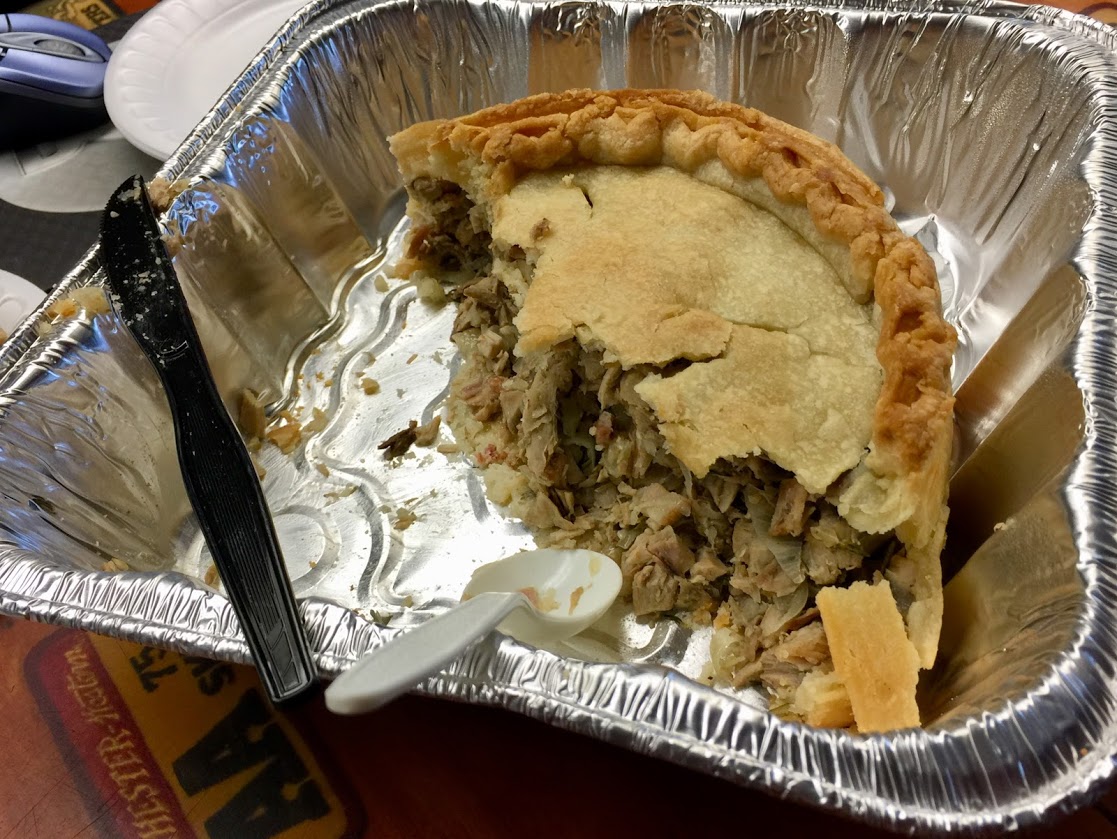
Pheasant and Onion Game Pie

     This season, for a number of reasons, I shot more pheasant than any other game bird. I enjoy eating pheasant, and having used pheasant in game pie in the past I thought I would expand upon that. Pies are relatively easy to make, and are the perfect way to use the often overlooked legs and thighs of the bird. Truth be told, the legs and thighs are the absolute tastiest bits, and not using them is depriving yourself of a real treat. When I dress out birds I generally separate the breast from the legs and thighs, saving all the legs and thighs in one big bag, and saving the breasts paired up in smaller portions. Whatever your routine, consider saving the legs and thighs for a separate meal of some type.

     For this recipe you will need:
             
               8-12 pheasant legs and thighs
               1 large onion (yellow or red)
               1-2 shallots
               Butter
               2 ready made pie crusts
               1 egg
               poultry herb mix (sage, rosemary, thyme)
               salt and pepper

1- Place all the legs and thighs in a sauce pan and cover with water. Bring to a boil, then simmer for about 1 hour.

2- Remove the legs and thighs from the water, set aside and allow to cool for about 1 hour. The water can be strained and saved (highly recommended) to be used as a soup stock later.

3- Once the meat has cooled sufficiently, by hand strip all the meat of the bones and set aside. Discard the bones and tendon bits.

4- Dice, or slice if you prefer, the onion and in a deep sauce pan begin browning over medium heat with a good chunk of butter. While the onions are browning mince all the meat and mix with the herbs, diced shallot, and S & P.

5- Add the meat to the onions, and mix well. If the meat still needs some cooking heat through over low heat. At this point you can add a bit more butter if you wish.

Now it is time to fill the pie crust. Each ready made crust has it's own handling instructions, on how to top a pie, and defrosting, but generally you will need to allow the crust to defrost enough to pinch and seal the edges of the top crust and the bottom crust. Anyway,...

6- Fill the bottom pie shell, place the other pie shell over the top, cut a few vent holes, and brush the towpath egg.

7- Bake in a 400 degree oven for 20 minutes. The meat should have been already cooked through, but  if you are uncertain you can lower the heat to 300 degrees after 20 minutes and cook an additional 10 minutes.

Additional Tips-

     I like to make this pie in a spring form pan. As the pie crust defrosts it becomes malleable, and can be formed and pressed to fit.


     Once baked, this pie can be reheated by wrapping in foil and heating at 350 degrees for 30-40 minutes.


Ready to go in the oven.

Fully cooked.

Reheated the next day, this pie didn't last long at the skeet club.


Thursday, December 6, 2018

Resurrection, Bringing ASO back to life.

     It will no doubt have been noticed by followers and regular readers of this blog that it has been some time since my last post. It's not that I haven't had anything I wanted to share, but rather a case of having too much to do, and not much free time to write in the evenings. Well,...I'm back. Keeping this blog relevant is, and always has been important to me, and it's time I get rolling with it again, and regularly writing, again.

     I have done plenty of things that could well have been written about, but time has passed, and many of the details are now blurry, so I doubt I'll be writing about them. That said, I shall give you a quick peek at what I failed to share with you all.

     In the spring I organized a shooting clinic, which was held at Green Mountain Shooting in Ossipee New Hampshire, for the Ruffed Grouse Society. A number of people came out to listen to lectures on grouse habitat, hunting equipment, guns, chokes, ammo, as well as receive a bit of instruction from Green Mountain shooting coaches while shooting their sporting clays course. Oh yeah. There was a fantastic BBQ meal, too.

     My pup, Bailey, made his field trial debut, too. Bailey ran under Steve Church in the open stake of the Patriot Sporting Spaniel Club's Springer trial held in North Conway New Hampshire back in September. Bailey had a great first series, but took a little walk about during his second series. While nothing Bailey did during his walk about got him dismissed, it was behavior that needed correcting so Steve made the decision to pick him up. While it didn't go as planned, it was far from a disaster. Anyway, what could reasonably be expected when entering a 14 month old in an open stake?

Training with Bailey


     There was a bit of hunting, too. While I didn't go out to the grouse woods as much as I would have liked to, I did have a few good days on the woodcock, and pheasant. I explored new cover in my home state of Massachusetts, and as feeling hopeful for the grouse population, here.

Massachusetts Woodcock

Pheasants shot at the club


     Oh Yeah. I went to England to shoot driven birds again, too. This was my 4th year going over, and was fortunate enough to be invited for a 5th visit. I will make every effort to return.


England photos by Sue Bell


     Outside of my outdoor pursuits I am happy to report that the high school rugby club where I coach made it to the finals for the 6th time in 6 years, and won it for the 3rd time in that same time period.


Wildcats Rugby, players and coaches.


     Anyway, It's good to be back.