Showing posts with label driven birds. Show all posts

Monday, January 1, 2018

A Season To Remember; Woodcock flights and England Flights. Part 2

England Bound

     A couple weeks after my last trip north, with my banner woodcock day still fresh in my mind I found myself sitting onboard an Aer Lingus flight to England. Last year when I was in England it was suggested that I spend a bit more time, and get in a few more shooting days. So arrangements were made, and I was off for a 2 week shooting adventure. The trip was scheduled to have me fly the red eye a Wednesday, and depart 2 weeks later on a Wednesday. This gave me a few days of acclimation before my first shoot day, and a few recovery days after my last, with 4 shooting days scheduled from Saturday to the following Saturday. The days in-between shoots would be spent driving the countryside, and exploring outfitters and businesses catering to the shooting community.

Watton

     My first shooting day was with the Watton-Carrs Syndicate in the Driffield area of east Yorkshire. My host PP and I were on the road to the shoot early, watching the shy brighten through the windshield of his truck. In what has become a bit of a tradition, just prior to arriving at the shoot we stopped at the farm stand for what may be the best sausage sandwich in England.

     Arriving at the farm I made the rounds, catching up with those I'd shot with before, and meeting new members I'd not.  As the cold was stamped out of toes, dogs allowed to run out a bit of energy, and pie money collected the day began to take shape. Pegs were drawn, and we headed out.  Coincidentally, a guest gun, T,  who I'd met last year was shooting with the syndicate again, adding  yet another level of familiarity to my trip.

     I don't remember which number I drew, but I was stood out in a field facing a wood. There was a hedge and a ditch to my right with PP on the next peg over the hedge. To my left other guns lined out through the field. Soon the shooting began. I've been on somewhat of a quest to shoot a European Woodcock, and late November, and December are when the Woodcock are in Yorkshire. As fate would have it the cry of "Woodcock!" could be heard down the line, a shot rang out, and PP tumbled a good woodcock that had flown the hedge between us. A second woodcock flew the hedge, but I held back, it flying just above the height of the hedge. Not high enough or safe enough to be of my liking.  I mightn't have killed a woodcock, but I would be carrying one out after the drive, PP's woodcock having fallen my side of the hedge.


     The day would have it's moments, and it was the second drive I was to shoot on that I remember the best. It started out all wrong when syndicate member Bubbles tumbled down a steep embankment into a wet ditch. Somehow he managed to keep gun, cartridges, and cell phone out of the 6" of water at the bottom. It is remarkable the protection from the elements a good set of tweeds can provide, Bubbles only a bit damp in a few areas. After hauling Bubbles up the bank we proceeded to our pegs and continued shooting.  On this drive I was stood on a ride between a wood to my left, and "Bubbles Brook" and a hedge to my right. The shooting was much quicker, snap shooting, and at some point I got a good look at nicely presented cock pheasant which I folded with my first shot. The bird tumbled into the wood hitting every branch on the way down, before bouncing off a plastic drum feeder ringing it like a bell, which got a chuckle out of those who witnessed it. After the drive had ended, as we collected our birds and made our way out of the wood Bubbles emerged with a fox that had been pushed right to him by the beating line. A bonus, indeed.

    Like always we all stood 3, and beat 3, and had several memorable moments. Like can happen, I'd not drawn the best pegs, and I don't recall how many birds I killed, but I'd killed the one's I'd felt I should have, and had a great day. Shooting with a walk 1- stand 1 syndicate is about much more than just killing birds. The time spent beating and putting good birds over the line, and the craic are equally important.

Cropton

     On Wednesday I found my self again in tattersall and tie, this time heading out to shoot with another walk 1- stand 1 syndicate in Cropton where I was able to fill in for a regular member show couldn't attend.  Cropton is a bit different from Watton. Watson shoots over fields, with the birds being driven from woods and hedges. Cropton is a woodland shoot. Some birds are driven over fields, but many drives are also out over breaks in the woods. the topography is very much like where I hunt grouse and woodcock in northern New England, and some of the woods I saw at Cropton I would have been more than happy to rough shoot for woodcock over a spaniel. Another difference is that Cropton employs the use of a shoot trailer to shuttle people around.

     Cropton was interesting in many ways. Again, and I wouldn't know this until the day had ended, I didn't draw good pegs, from a shooting stand point, but from a spectators point of view they were pretty damned good. The first drive of the day was awesome. I was part of the beating team, but the wood didn't require all of us, so I was stood behind the line of guns and tasked with marking and picking up shot birds. The guns were stood in a line in the bottom os a steep valley with a stream just in front of them. The beaters pushing birds from high on top of the opposite side, which had been logged. The birds came high and fast, some curling on set wings, and descending slightly to make for tricky shooting. Sometimes coming in small flushes, and at other times coming in singles and pairs this drive was exciting to watch.

     My first drive was like none I'd seen before. I was stood in a somewhat marshy area that looked more like somewhere one would hunt moose. Surrounded by tall pines the birds came by in singles and pairs. The shooting was quick, snap type shooting, but with more of a window than when I was stood on the ride at Watton.  I got in a fair amount of shooting at marginal birds a bit far, or crossing in front, which I didn't mind missing very much because they were marginal, but when I good cock pheasant came over, trying to get past between me and the gun to my right I was happy to fold him into the baby pines and thick underbrush behind us. Fittingly, it was PP's cocker, Snitch, who was on pick up duty in my area and picked my bird.

The walk in to the first drive I would shoot at Cropton.


     As the day progressed I was on a peg in the middle of the line, in a field looking at another wood I was certain would hold woodcock. On this drive PP and snitch stood at the ready to load and pick if needed. Neither was to be, and the same 2 cartridges I dropped in to my 20g Browning O/U made it back into my pocket after the drive. The drive, however, proved to be great to see some good high birds killed. The second and third guns down the line to my left, closest to the bordering high pines were on hot pegs, were shooting with some efficiency. I've seen some nice YouTube videos of good high birds being killed, but there is nothing like watching it as it unfolds. Were these towering birds? No, but they were consistently right around the 50 yard mark. It was a pleasure to watch.

Myself and Snitch on The Spectator Drive. The gun stood next to the treelike behind me in the picture has some awesome birds come over him. It was a thrill to see some high birds killed.


     Later I would have the pleasure of watching Snitch in the beating line as we beat a big brushy cut towards a swath of pines, the guns stood on the farm road on the other side. The beating line produced plenty of good birds for the guns, but it was at the bottom when twice Snitch turned on the wind, and drove in on tight sitting birds making good hard flushes.


The cut we pushed where Snitch did some great work.


     The day concluded with everyone making their way to the Blacksmiths Arms for a post shoot drink and a full dinner. While I had not drawn a hot peg, and had only killed one bird, I was happy with the way the day played out.  got to see some spectacular shooting, some sporting birds, mouth watering drives, good dog work, and met some great people. Like I said, it's not about killing birds, but about a day in the countryside with good friend and good people.

Escrick

     We would pick up the shooting again 2 days after Cropton with a visit to the Escrick Park Estate just south of York. In planning my trip I was presented with the possibility of being part of a team of guns being assembled for a day at the estate. I had never been on an estate shoot, nor even taken part on a fully driven day. Until this point all of my driven shooting had been walk 1- stand 1, but now I would experience nothing but unadulterated shooting for 5 drives on a 150 bird day.

     The day began before sunrise as the team of 10 guns dressed in their finest tweeds assembled at the shoot lodge for a full English breakfast before heading out for the first drive. Over sausage, beans, toast and coffee the day's craic began to get going. The shoot manager arrived as we were finishing off our coffee, gave us the ground rules, and we drew pegs. Escrick uses an old method of moving up and down pegs on successive drives; Odd numbers move up, even numbers move down. This means on each drive you will have different neighbors. I drew peg 2 for the first drive. This would mean on the second drive I'd drop to peg 1, then 3, 5, and 7 respectively. I didn't know it at the time, but my poor peg slump was over, and I'd be on some hot pegs.

\
An Escrick Park estate dog.


     The first drive had the line of guns in a field facing a tall hedge about 75 yards forward, other about the same distance behind. Standing on my peg I was doing all I could to try to ignore the numbing cold in my fingers. The weather had turned and a bitter cold had settled on the area, and the wind was howling. My the numbness and tingling made me begin to doubt whether I'd be able to slip off the safety, and pull the trigger. I'd soon find out when a good cock pheasant came over to my left. The cold forgotten about I turned, and swung the gun on the bird. Well, not only had I forgotten about the cold, but I also forgot about the safety, and my gun remained silent. It was only minutes later that partridge began streaming over the hedge in small coveys, and while none actually came my way I got to warm my barrels a bit trying to secure a few my neighboring gun had missed as they went out the backdoor. I hadn't expected to be shooting partridge, and it was a welcome addition to my species list. I can also attest to how exciting they are when they come streaming over a hedge.

     On the second drive I was assigned to peg 1, which was a walking gun. This drive was similar to the first with the guns facing a hedge, but much further away this time. The beating line moved roughly perpendicular to the line of guns on the other side of the hedge. That was where I came in. the walking gun is responsible for birds that try to break back over the beaters. And they did. No sooner than the drive had begun, 2 partridge tried to break over the hedge and back away from the line. They failed, both being brought down by my bottom barrel. As the drive progressed others, both partridge and pheasant tried to exit stage left where I was waiting. Some made it through, some fell on my second shot, and a few were exactly the kind of challenging connections we hope for. About a third of the way through the drive a hen pheasant, broke back over the beating line, high and well over the hedge. Swinging through I secured the hen with a single pull of the trigger, and getting a rousing cheer from the beating line who'd seen it, appreciating that their hard work was not wasted. A few minutes later a cock pheasant tried the same escape route, and like the hen, was brought down with a single shot, again making the beating line happy. The shoot manager, who had been walking with me remarked that its a good thing when the beaters like your shooting. "Make sure they know it was the Yankee doing that shooting" was my reply. At the drives end I'd killed 6 or 7. I was happy. Off for a bit of elevensie.

A happy gun? Or trying to catch a ride on the wind?

Mixed bag at Escrick


     After elevensie we lined out in front of a game crop which was pushed towards us. I was stood with a hedge and a ditch to my left, with a tree straight in front at the edge of the game crop. While the tree was well ahead of me it shielded my view of incoming birds making the shooting a bit tricky. Unfortunately the birds had the wind to their back which did 2 things; make them fast, but put them on us before they had much height. By the drive's end I'd passed on a number of low birds, missed some good birds, and put pellets in 2 others. The added speed meant I'd need added lead, which I hadn't quite gotten my head wrapped around. That said, I'd pricked hard both a partridge and a pheasant which sailed to where the pickers-up were waiting.


The line of guns to my right on the 3rd drive.


     The fourth drive was interesting. I was stood on a ride in the wood with some of the guns lined in the field to my left, and others in the wood to my right. The shooting was snap shooting, with only a small window. The birds were coming over me, but in the shade, with the sun low in the sky my eyes were playing tricks on my. I was having a tough time judging distance, and many times birds were over me quicker than I'd expected. But the cry of "Woodcock!" kept me alert, and twice I had opportunities, though fleeting. The first woodcock passed low, left to right, but climbed as it went over my neighboring gun. A tree between us blocked a bit of my view, but the woodcock quickly emerged high over my neighbor before making it through without a shot fired. The next woodcock did almost the same thing, but passing right to left, gaining elevation. As the woodcock rose I began to swing and mount but the bird made it through a small strip of trees and out over the gun to my left, who made a fantastic shot on the now quite high woodcock. That was not the only woodcock killed on that drive, with J N nearly, but for a technicality, getting a left and a right on woodcock. A good woodcock came over, which he killed. He then took the gun out of his shoulder just before a second woodcock appeared. He then brought the gun up again, and killed woodcock number 2 with the unfired cartridge in his second barrel. Here in the US, killing 2 birds in flight, each with a successive shot is called a double (L & R in the UK). If the report of the gun is what puts the second bird in the air, and it is then killed, we call it a scotch double. J N, not sure if both birds were in the air at the same time, I'd credit with a scotch double.   I, however, would only have but a few spectacular misses on this drive.

JN with his 2 woodcock.

     The fifth and final drive had the guns lined out along 3 sides of a wooded outcrop of tall thick pines. As the beaters approached birds began to filter out, but it was clear that many of these birds had seen a line of guns before. Most of the pheasant  curled around and flew back in to the woods over tree top height before a shot could be fired, the partridge coming out low, many flushing not from in the woods, but when they reached the end. Still, some birds flew nicely, and I was able to kill a few good partridge.

A couple of the pickers-up,....

..and the fruits of their labor.


     The day at Escrick ended much the way it had begun, with the gun team sitting down for a good meal at the shoot lodge. While it was supposed to be a 150 bird day it didn't quite turn out that way. We ended up a bit short with a bag of 104; 36 pheasant, 63 partridge, 4 woodcock, and 1 pigeon. We racked up this bag with 406 shots, for a pretty good ratio. I had finally gotten some good peg, and had some quality birds, and I added another species to my list, having killed my first Red-Leg Partridge. Could the day have been better? Well, I was happy, but I could see why some of the others weren't thrilled. The bag was 1/3rd short, and while we were shown enough birds to have met the bag, a lot of those birds just weren't sporting. Some, as in the case of the last drive, just weren't even shots. I know it is hard to manage a shoot, but I would expect there to be contingency plans for days when the wind, or weather, is a factor. Surely there are drives that show better in such conditions. Anyway, Escrick shall not be judged on just one shoot. Conditions were tough, and given the opportunity I would shoot there again. just hopefully on a sunny, warm, still day.

Have you ever seen a better looking team of guns?


Part 3, The Sticky Toffee Pudding Massacre, coming soon.


Friday, December 30, 2016

England, Part 2. Musings.

     Since I've been back from my shooting trip to England, last year, I've been giving a lot of thought to the state of driven bird shooting here in the US. Over all, it does not exist. Why not? There are plenty of sportsmen who would give it a try. To a degree the interest is there.

     Around the country numerous shooting preserves hold regular tower shoot where pheasant are released form a tower of some height to fly over the guns who have formed a circle at some distance around the tower. These shoots are usually called European shoots, but truth be told, they are nothing like a driven bird shoot. Some clubs offer a different form of "driven" bird shooting where birds are released from a hill top over a line of guns in a valley below. These shoots often have more than 1 "drive" and the guns move around the property, and change pegs as they would at a real driven shoot. In fact, some of these shoots are quite authentic, like the shooting offered by Royal United company. But it's not "driven" bird shooting. Then there is Blixt and Company. They offer true driven bird shooting out west. Something, however, tells me that this isn't exactly affordable for the average household. Driven bird shooting shouldn't be something that anyone can't aspire to partake of. And it needn't be. The syndicate I shot with in England is a DIY syndicate. The members do all the work. They don't hire a gamekeeper, nor beaters to push the birds over them on shoot day. Before the season they all pitch in and make repairs to the bird pens and feeders. They take delivery of the pheasant poults and care for them. They haul feed, and fill feeders all during the season. On shoot day they split in to 2 teams, red and black, and alternate shooting and beating the cover. This form of syndicate  operates on a walk1-stand 1 format, and is common in the UK.

     What is keeping us from having driven bird shooting here in the US? I think the biggest factor preventing the formation of driven bird syndicates in are the bag and possession limits on game. Unlike in the UK, here the game birds belong to the public, and limits have been established to ensure a fair distribution of the resource, and to prevent game hogging. It'd be hard to get a people involved in a syndicate when they could only shoot 2 pheasant a day. In fact it'd be probably too much effort to organize a driven day for such a small bag. Coupled with the fact that it'd probably be pretty hard to find a property in many states with enough birds to make the day exciting. Here in the east, most pheasant are released by the state, and they aren't exactly releasing all that many. A solo hunter with a good dog has a better chance at killing his limit, in a shorter time, with less effort than would be done working in unison with a syndicate. Of course, a day of driven shooting isn't just about the number of birds killed. Driven bird shooting is a social affair that involves shooting birds. Still, trying to organize a syndicate, and drives when there just aren't many birds around isn't very inspiring, and unless the local arrangements are second to none, I doubt there'd me many repeat customers. But that isn't really too much of a problem. Shooting preserves have long been established, and because they raise, and release their own game birds have been exempt from the bag and possession limits. The special rules for preserves is what allows Royal United to operate, and why tower shoots exist. So why not a preserve dedicated to driven bird shooting?

    I think it's time to form a driven bird syndicate, and get some true driven bird shooting going here in the US. Why not get a syndicate started, and find a property which could be licensed as a shooting preserve, and spend a few weekend each fall doing a little walk1-stand 1 driven shooting? I have a hard time believing that I am the only one in the New England area with an interest in driven birds.

     Here is a link from the Shooting UK website to an article, How to start your own DIY shoot. While I don't think we would need to do everything the way the article suggests, and couldn't do some of it, I do believe that with the right base of people putting their heads together a driven shooting syndicate could be a reality. So, what do you say? If you are in the New England area, and have an interest in driven shooting, and would like to see a syndicate formed dust off your tattersall and tweed, and send me an e-mail.


Monday, December 26, 2016

ASO goes to England, again.

     Sometimes things just fall into place, as was the case last year when I was lucky enough to spend a day shooting driven pheasant in England, so it seemed almost to good to be true when I found myself on a plane headed back to England to do it again this year. There seems to be some truth in the saying "birds of a feather stick together". Last year I met, and fostered a long distance friendship with several members of the Watton Carrs syndicate whom take their shooting sports as seriously as I do. They saw fit to invite me back to shoot again this year, and like last year, naturally I was excited to make the trip.

     The trip mirrored last year's trip in many ways, except rather than staying a week, a few days of which were shopping in London, I'd pretty much just make it a stretched out weekend; fly out Wednesday night, arriving Thursday, enjoy Friday, Saturday, and Sunday in the Yorkshire countryside, then fly back home on Monday. And that's what I did.

     The red-eye out of Logan airport, to me at least, is brutal. I just don't sleep well on a short overnight flight, so like last year I'd planned an overnight in Manchester. Early check in at the hotel allowed me to get in a few good hours of sleep before hot shower, and an evening meal with my friend CK, who lives in Manchester and works at the university there. CK and I, after a quick pre-dinner drink at Brown's headed over to Sam's Chophouse for what was an outstanding feast, in a fabulous atmosphere. With neither CK nor I really being well versed in the art of wine selection, we followed the advice of the seasoned and saucy waitress and ordered a red. I can't speak to the quality of the steak and kidney pie CK enjoyed, but it sure looked as if he was enjoying it every bit as much as the lamb chop and cauliflower I ordered. Absolutely delicious. But it didn't stop there; we couldn't resist their puddings, and it was there that my sticky toffee pudding (with an excite dollop of clotted cream!!) addiction was born. After dinner we strolled to a new pub in the area which CK claims would be right in my wheelhouse, owing to the fact that it is home to some 400+ single malt scotches.  He was right. The Britons Protection was a scotch drinkers paradise, and I was happy to help them drain a bottle of Longmorn.

     Friday morning I awoke before the sun. Not because I woke up early, but because I forgot that the sunrise is a bit later there than I am accustomed to. My plan for the day was simple; pack, eat breakfast, then jump on a train to Leeds to meet they guys. Now, let me say this; I love a good breakfast, and don't think anyone does breakfast better than the Brits. So I headed over to Cafe North, a spot my wife and I stumbled upon a couple years ago, for a proper (by proper I mean huge) breakfast, which I thoroughly enjoyed. Having a bit of time after breakfast I decided I'd swing by J. Wippell & Co to see what country clothing they had in stock. If you're not familiar with Wippell, be prepared for a bit of confusion. Wippell is a clothing store that caters to the church, and sell everything a priest might need. They also have a small men's wear shop with plenty of tattersall and tweed. But don't go looking for them online, as their internet presence is minimal. Do take a walk by their Princess St location should you find yourself in Manchester.

Wippell & Co. Princess St. Manchester
A big British breakfast

    In the afternoon I caught my train to Leeds where PP would intercept me. From Leeds we headed north to Ripon where PP had arranged an evening of duck flighting with a local gamekeeper. In North Stanley we met up with SL, CC, and the gamekeeper, and headed out to a small, brush choked pond to shoot some ducks. The evening provided some fantastic sport with lots of ducks flying over, and coming in to the pond. Shooting roosting ducks in the dark is fast, exciting shooting. Unfortunately, my eyes aren't what they once were, and I've been told (rather asked) why I didn't shoot at a number of the ducks which dropped in, or passed by me. Of course, when my best opportunity presented itself my Browning Citori 20g decided it didn't like the heavy British shells I popped in to it, and didn't fire, so I got to watch a couple fat Mallards fly off while I broke and rechecked the gun. None the less, it was a fantastic evening, despite my only dropping one lone teal. After the evening's shooting we found our way to the Staveley Arms for dinner. Again, another outstanding meal, in an absolutely fabulous atmosphere, and a top shelf sticky toffee pudding.

     Saturday morning I again awoke well before the sun. This time it was by design, as PP and I were off to the farm where we would meet up with the shoot captain TH, and a few others with whom we'd line the edge of a field a short distance from a reservoir popular with the geese. The idea being that as the sun rose, so to would the geese who would fly rather low over the field, and hopefully one of the guns. That is exactly what happened. The geese chatter from the reservoir would get louder and more excited before a skein would decide to make their exit. Their flight path took them directly between me and T, and pretty much out of reach of both of us, but twice the geese banked to the left, and into the restricted air space T was guarding. The first flight escaped, however the second was not so lucky, and T had the first kill of the day. He'd also be saddled with carrying the heavy beast back to the cars, but that's the price you pay, and any of us would have been happy to be in his shoes.


     After the geese stopped moving we made our way to the barn where we would meet up with the balance of the syndicate, and get the day organized. Earlier in the morning PP was suddenly overcome with worry. In the morning, as we set out, his morning routine was somewhat put off having me in tow, and the question of whether or not we closed the front door of the house could not be answered. Being a guy who is lousy with names, and seldom remembers people out of the context of which I know them, I get it. So, PP was off to make a quick round trip home to make sure his place was secured. At the barn the rest of the syndicate gathered, where I caught up with members I'd not seen since last year, and was introduced to new members. The teams were named, the drives announced, and pegs drawn. Then we were off to the first drive where the team I was assigned to would be beating. Armed with stout sticks, noise makers, and hype dogs we held a line across the cover, and pushed through sending birds out over the line of guns. To my pleasure a dog flushed a big woodcock right in front of me, which flew back across the beating line about 4 feet directly over my head. While this wouldn't make the guns happy, it have me my first opportunity to see one in flight. When we hit the end of the woods/cover the whistle was blown signaling the end of the drive. The guns were cased, birds picked up, and everyone gathered to organize for the second drive. The decision was made to break for elevensies early, then shoot 2 drives before lunch, so out came the cake, cheese, meat pies, port and brandy.


The beverage selection 
I've been caught enjoying a cake and port during elevensies.
But, how does she stay so clean?...


     After a short belly warming break we were off to the second drive. This time I would be a gun, and found my self standing out in a large field between were the cover woods ended, and a hedgerow behind. The birds started coming out at a pretty good rate, and at a decent height. My neighboring guns got in some good shooting, and I got in a few shots at birds on the edge of my range that my neighbor missed, but not many flew over my airspace. On the drive I did have 2 good birds come over, but I missed. The first flew directly over, but I failed to give it enough lead. Another good bird flew over high to my left. Not wanting to rush, or swing in a manned that would cramp me, I turned and took a step with the intent of taking the bird as a high R-L crosser. Problem was, when I stepped I  my foot hung up on a hummock in the tall grass, and rather than swinging the gun I was doing dancing a jig with it trying to stay upright. Two long shots as it exited the back door had no effect on the bird. Oh well.


     The day would go on pretty much the same way, alternating between beating, and shooting. The sun broke through the clouds, and the day warmed up enough that Layers were shed, and my sweater deposited in the truck.  Unfortunately, I didn't draw the best pegs, and after my first drive I never pulled the trigger again, save for one suicidal woodcock which few the entire line of guns late in the day, untouched by all, though we tried. Nevertheless, a good day on a shoot isn't summed up solely by the number of shots, nor the number of birds killed. It's about much more than that, and I enjoyed every minute of the day. I took pride in knowing that our team put good birds over the line of guns, and found the steady stream of pheasant flushing infant of me quite exciting. I can see why non-shooting people enjoy beating. At the end of the day we had a bag of 50-something pheasant, 5 woodcock, 1 pigeon (which PP killed with a fantastic shot), 1 hare, and there was armor that a partridge, too was killed, but I didn't see it. While I didn't kill any of these, I certainly feel I earned an assist.


     After dividing the game amongst the guns PP, SL, and I were off to do a bit of duck flighting again. Neither the ducks, nor my eyes cooperated again. A few teal flew in low, and in the shadows, unseen by me. Down the line a few flew in where the guys got off quick shots, but they were gone just as quickly. The only duck I saw was a teal silhouetted in the sky as it tried to escape high over a hedgerow. I was quick enough to ruin it's plan, and dropped it on the far side or the hedge.

     In many parts of England, like here in the states, there is no hunting on Sunday, so PP and I after a relaxing morning headed out for a drive around the countryside, and a bit of sightseeing in York. Then, in the evening we opened a few beers, popped some finger food, and a game pie in the oven, and tuned in to the football game. And by football, I mean the NFL. PP, like myself, is a New England Patriot's fan. Watching the Pat's beat the Ram's was a great way to cap the weekend. Monday morning I was again up before the sun, and on my way home.


     I'd very much like to thank the members of the Watton Carrs syndicate for again allowing me to shoot with them. I would also like to offer a special thanks to Melanie, Claire, Tom, and Shaun, who's pics I have pirated, and used in this post. 


Wednesday, December 16, 2015

ASO Goes to England, Driven Bird Shooting

     It's long been a dream of mine to travel to The UK to do some game shooting. The UK sports a variety of game shot in a variety of ways, many of which are quite different from the way we do them here at home. There are also many different species, though some are quite similar some found here. For example moors in the north of England and Scotland hold Red Grouse and Black Grouse, two species not found here. In other parts of the country you will find Grey Partridge, and Spanish Red-Leg partridge, birds that are very similar to Huns and Chukar, respectively. There are also Pheasant and Woodcock, but unlike here in the US both species are larger in size, the European Woodcock being nearly 3 times the size of the woodcock we shoot here. The British countryside also has a robust population of Wood pigeon, which looks similar to the Rock Doves we call pigeon. They, too, are a bit larger is stature.

     My dream was finally fulfilled when I won a day of driven bird shooting in England in a small, online auction. It was time to pack my tweed and wellies, and hop on an airplane headed east. I would be spending a day in East Yorkshire, not only participating in a driven Pheasant shoot, but also shooting geese in the morning, and ducks in the evening. And, seeing as I was flying across the Atlantic, I figured a couple days of "shopping" (which is code for visiting gun rooms) in London was in order. So, after some consultation with my host, a plan was formulated, and off I went.

Puttin' on the tweed


     My host, Rick, is an American wingshooting and bird dog enthusiast who has lived in England for some time. As part of the offered shoot, Rick generously put me up at his home for the weekend, and loaned me his 12g O/U, as bringing a gun to the UK, while not impossible is difficult. Spending the weekend at Rick's provided the additional pleasure of eating a couple of his delicious home cooked meals (I think he may have been showing off a bit), and snuggling with his sprightly 11 year old Lab Roxie, and his affectionate 4 year old Wire Haired Vizsla Ruby. As the shoot day was schedules to start well before the sun rose, and end after it set, it was a good idea to stay at Rick's house. Another good idea, was my decision to stop over in Manchester on my way to the shoot. I find it easier, and easier to admit these days that I am not young anymore, and sleep has grown in importance to me. Taking a red-eye flight, and then immediately hopping on a train to the counrtyside would have made me a lousy, groggy guest, so I planned a jet lag management stop over enroute. Though I will admit I had a bit of an ulterior motive in stopping over in Manchester. Regular readers of this blog will recall that last summer I was in Manchester attending a youth soccer tournament.While there I found a couple of places to have a good meal; one a nice dinner, the other a nice breakfast. I would be in need of both a dinner, and a breakfast. And so it was decided; One week of travel to Manchester, East Yorkshire,and London.

Me and Rick prior to going duck shooting

     My travel to Manchester was completely uneventful, and seamless. I was able to check in to my room a bit early, and get in a nice nap before heading out to enjoy a few drinks and dinner with a friend. The next morning I made my way to the cafe I had been hoping to eat my breakfast at, and I was not disappointed. After breakfast I wandered the Manchester Christmas markets a bit before catching the train to Hull where I would meet up with Rick, and the shooting adventure would begin. At Hull Rick found me rather easily, my large suitcase in tow being a great clue, and we made our introductions before heading to Rick's home via a quick stop off at a local gun room. It was there that my education in British game shooting began. The land we would be shooting over is a working farm, the fields of which periodically house sheep. Because of this, and a sheep's willingness to eat absolutely anything, it is a requirement of the land owner to shoot only shotshells with fibre wads, as these wads, if eaten by a sheep will not harm it. Truthfully, I think this a great idea, and have begun researching fibre wad ammo here. Why litter the woods with plastic if we have an alternative?

     Shoot day started off early, well before the sun rose. As we drove to the farm in the darkness, and anticipation, we discussed a more in detail the customs of British game shooting, and the rules, both written and unwritten. Like here at home, safety is the number one concern in the game shooting community. Unlike here at home, game may be shot both before, and after dark. At the barn we met up with a couple members of Rick's shooting syndicate who were also keen to shoot a few geese, and I was soon settled into a sparse hedgerow alongside a field known to be the gathering spot for hungry geese in the morning. Optimistically I sat hoping today would be the day I dropped my first Pink Footed, or Specklebelly Goose.  Before long I had an opportunity in the predawn dark at a pair of ducks flying in from behind. However, the ducks were over and gone well before I even registered the whistling of their wings and saw them. The skies were overcast, making the sunrise seem like it was never going to come, and hampering long range vision, but off in the distance we could see and hear geese doing their thing. Problem was they were doing it way down the other end of the very large field, and well out of shotgun range. It wasn't long after a small flock of geese flew in to the far corner of the field that a shot rang out from the opposite hedgerow where the others were sitting. Shortly after the shot a few geese broke from the tree line and headed somewhat my way. The geese were not coming directly over, but were cross right to left out near the edge of shotgun range. I sent two rounds of steel in their direction, with a net result of zero. Oh well. At least I'd gotten to see, hear, and shoot at, a species I'd never encountered before. It was fun anyway, as water fowling tends to be, and honestly this is how so  many of my homegrown water fowling adventures end.

     With the goose expedition behind us we headed to the barn where we'd have breakfast and I'd meet the rest of the Watton Carrs syndicate. We encountered a small set back at the barn. While Rick had remembered to pack breakfast and lunch, he'd forgotten the pan in which breakfast was to be cooked, so it was off to the farm store for a take out sausage sandwich, which was outstanding, then back to the farm where I'd meet the balance of the syndicate I'd not met at the farm store.

     In Britain shooting organizations take many forms. One of the most common forms is that of a shoot syndicate. Loosely translated, it's a private, organized club. Rick is a member of the Watton Carrs syndicate in East Yorkshire. The syndicate leases the sporting rights to a 2500 acre working farm. Leasing the sporting right gives them exclusive permission to shoot on the property. In the spring the syndicate buys, and releases roughly 700 pheasant on the property. Unlike the standard here in the States where pheasant are released just prior to shooting, the syndicate initially rears the birds in open topped pens, with small exits along the bottom which allow the birds out, but prevents larger predators in. The club sets out numerous feeders in the surrounding wood lots, as well, and soon the birds disperse and take up residence all over the farm. Once released these birds very quickly become quite wild, and strong fliers. The Watton Carrs syndicate is a small, DIY syndicate which does not employ beaters to drive the birds over the line of guns. Rather they work on a stand 1-walk 1 basis. This means in a typical 6 drive day every member will alternate between shooting on 3 drives, and beating on 3 drives, everyone working together to try to achieve the syndicate's goal of a 50 bird day. To do this smoothly everyone is assigned to either the red team, or the black team, which alternate between beating and shooting on every drive. This being the set up would allow me to see how a shoot is run in it's entirety my first time shooting in Britain.

     The driven bird portion of the day was spectacular in every sense. We met up with the rest of the syndicate members on the southern portion of the farm property, a short drive from the main farm. This was where the first 3 drives would be held. Prior to shooting the shoot captain gathered all the members, guests, dogs, and anyone else in attendance and held a quick introduction and safety brief. Members were assigned to a team, and pegs were drawn. Pegs are numbered 1-9, from left to right. While some syndicates have hard fast peg marked by a numbered stake pounded into the ground, Watton Carrs uses a bit more flexibility, and the shoot captain on each team shifts the approximate position of each peg left or right depending on the wind to insure the best shooting possible. After each drive, all the members shift 3 places to the right. I drew #9 in the morning, so I would shoot in the #3 position on my second drive, and the #6 position on my last drive. As it turns out, the # 9 peg on the first drive, Neil's Pen, was a walking gun position. As a walking gun I would walk the field edge, about 25 yards out, parallel to the woods towards the guns, about 10 yards behind the beaters. The job of a walking gun is to take care of any bird that tried to come out the side of the woods and escape back behind the line of beaters. This would actually work out quite well as an introduction to driven shooting for a number of reasons. First, it was very much how we hunt in our uplands, it would also allow me to be within ear shot of Rick (we were assigned to different teams) who could coach me, as he beat, through my first drive, and it would allow me to watch the # 8 gun who was well down the field.


The pre-shoot brief

     It didn't take long for birds to start popping into the sky out of the woods, and before long a big cock pheasant came out the side and curled back towards the hedgerow bordering the neighboring farm. This bird presented well, was a sporting L-R crosser, and was mine. Except for it wasn't, as with I failed to fully disengage the safety, and watched it fly off. My first British flub. I didn't have to wait too long for redemption, when another big cock pheasant tried to make a similar escape, but with a drastically different result, and I had shot my first driven bird in the UK. The remained of the drive was more of the same, with birds trying to make a back door or side door escape. Some were far, fast, and high, and lived to see another day, but an unlucky hen pheasant made the mistake of trying to fly right over me at a bit of altitude. She presented in the typical overhead British fashion, and I killed her with barrels nearly vertical, swinging through, and pulling the trigger a moment after blacking her out with the muzzle. I will admit, I was quite proud of that shot. After the whistle signaling the end of the drive we all walked the area picking up birds that hadn't been picked up by the many Cockers, Labs, Vizsla's and Spinone's in attendance. It was then that I cased the borrowed 12g, replaced it with a stout stick, and took my place in the beating line.

     The next drive was called New Road Woods, and the beating proved to be as much fun as the shooting. Armed with sticks the line moved forward towards the guns making as much noise as possible to push out the birds. The stick, I learned, is not meant for thrashing the underbrush, but for tapping on trees, and blow downs to make more noise. Unlike hunting our uplands, where dogs force tight holding birds into flight, sometimes nearly underfoot, these birds were getting out well in front of the beaters,a behavior no doubt learned by the weeks of syndicate shooting and beating. In fact I heard the report of the guns out front long before I saw the first bird going out. Like the first drive, after about 15 minutes of hooping and hollering, and a bit of gun fire, the final whistle sounded, and the bird collection began.

     Between the second and third drive we stopped for "elevenses". Elevenses is a British tradition of having a pick-me -up and a warm-me-up before lunch. The tailgates of two SUVs functioned as the buffet where we helped ourselves to beef pies, cake, and cheese. To wash it all down was a selection of port, brandy, Irish liquor, and Champagne. Unlike here, where alcohol and guns are overwhelmingly thought to not mix, a short drink often served, and enjoyed responsibly. Indulging is allowed at elevenses. Over indulging, however, is not.

     The next drive after elevenses was a drive called Wetlands. On this drive I was on the #3 peg, standing in the line, out is a well manicured grass field. From my peg I could see the small pond between the stone wall that marked the field edge, and the wood line that served as bird cover. This drive proved to be more challenging, with faster, higher flying birds. The pheasant would break from the distant tree line, and gaining altitude would come through a break in the thin line of trees that followed the stone wall. As soon as the birds cleared the hedge, and looking like they were coming straight over I'd begin my gun mount, and pretty much every bird found fit to curl to the right, putting the wind directly up their rear, right as my face hit the stock, forcing me to quickly readjust my line and swing, and shoot behind them, as they flew over my neighbor down the line. The wind had picked up considerable. So much so that it was impossible to converse from peg to peg, and caused the baffles of my ear muffs to keep closing.  One cock pheasant, however, made the mistake of not curling, and flying over high between me and the neighbor to my left, and I again enjoyed the satisfaction of folding a good bird in flight. A bit later I had a chance to toss lead at a bird through the backdoor as it escaped past the line, and watched it rock in the air, and begin a rapid, yet controlled descent. Sadly this bird had enough momentum to carry it to the treeline, which was the property line, behind us. After the final whistle about 8 of us, with a couple of dogs walked the property line, yet failed to come up with the bird.


The line of guns at the Wetlands drive

          After collecting loading the birds into the shoot wagon our caravan of cars and SUVs headed back to the main property for a quick lunch in the barn before resuming the shooting. When we resumed the shooting I was back on beater duty for the Elwood drive. This drive produced a fair number of woodcock for the guns, one of which Rick killed, as well as lots of pheasant. While Rick shot a couple of pheasant and a woodcock from his peg in the field, another member, Dave, had drawn the peg they call Bombshell Corner (forgive me; initially misremembered this as Car Bomb Corner). Bombshell Corner is a break where a narrow road cuts between two wood lots. When the birds come over they are high, and quick, and only give you a quick snap shot before disappearing into the woods behind you. Dave did well, shooting 4 out of the overhead break. The retrieval of the down birds was a bit tricky, as the area behind the peg was rather swampy, but a team of cockers swarmed the area and picked up every bird in the woods. One black cocker decided to welcome me with the nice delivery of a cock pheasant it had found, though I think the little dog was really more interested in just unloading it's find, and continuing the search.

Shoot captain, Tom, with his Cockers


     My final drive as a gun would be the South Wood drive, and I was plum in the middle on peg #6. On this drive I had a hedgerow to my back as I faced the cover about 100 yards across an open field. Again the birds had the wind behind them, and flew high and fast. This drive provided the added excitement of the birds coming out quickly, one after the other. While on the previous drives I had the luxury of time allowing me to casually pocket spent shells before dropping in new shells. This drive did not.  The bird that just flew over head had another, already out of the trees, somewhere behind it. Shells were ejected into the grass to be picked up later, as I fumbled to get new shells into the gun. This drive was fun, and the kind of shooting one doesn't deserve regularly.  Anyone who wingshoots regularly has missed shots, and missed opportunities that haunt them. Despite this drive not yielding many killed birds, the 9 gun team only killing 3 birds for 63 shots, there was nothing but smiles on the faces of the team. Nothing about this drive would haunt me. Just the opposite; I'd happily shoot it again, and with the same result.

     The line of guns for the South Woods drive were all positioned at the beginning of the beat for the Top Hill drive, which would be our last. So while we waited for the guns to get into position in the next field one of our team members collected our guns, and carried them out to the cars while we prepared to make our final drive by passing around a flask of brown liquid for a well deserved parting shot. Soon we were beating the last hedgerow towards the steady sound of shotgun blasts.

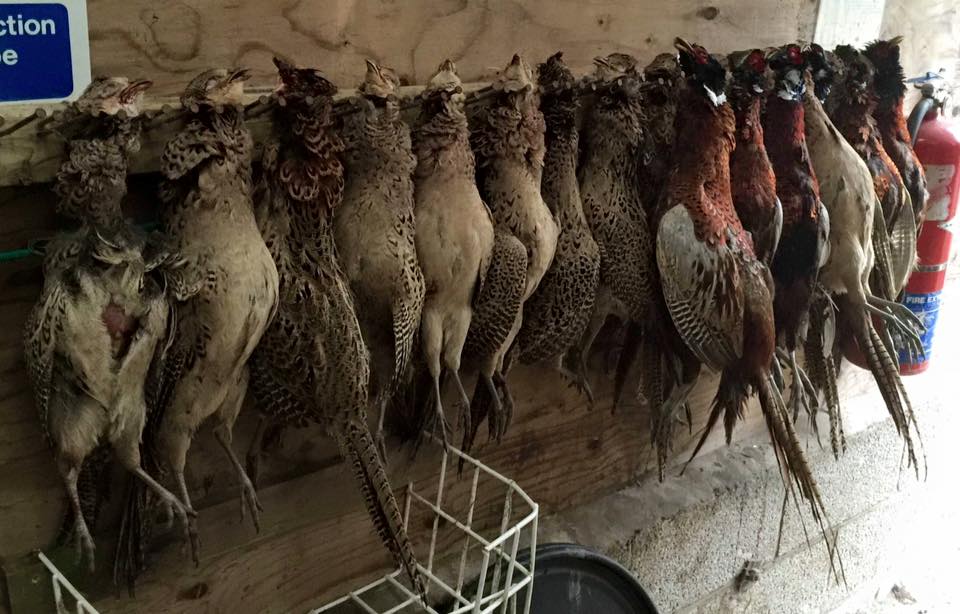
     Back at the shoot barn Tom went through the post shoot ritual of reading off the day's tally. On this day, with 18 guns alternating the shooting, we killed 36 pheasant, and 2 woodcock.


Hanging birds, and a happy beater


     My day wasn't over yet. there were still ducks to be killed, so after a bit of a break, and some minor equipment changes, we made our way to the small pond at the end of the Wetlands drive to wait for the ducks to start coming in. The duck shooting took a very British form, too. Not restricted to daylight shooting hours, we were shooting ducks in the dark. The silhouettes of ducks, coming from behind us in twos and threes would drop quickly into the pond. Then the sky would lighten momentarily with muzzle flash. In most cases the initial shot at the dropping ducks would be a miss, but the follow up shots on the now flaring ducks would cut down at least one, which Roxy the Lab would happily retrieve. Not sure I'd be able to adjust to shooting in the dark, I found that even I could find away to get the muzzles pointed in the right direction, and killed a Mallard. After about an hour of solid darkness, our small team of 5 guns had killed 5 ducks; 2 Mallards, 2 Eurasian Wigeon, and a Teal. And I'd learned that shooting ducks in the dark was both effective and fun. With a full day of shooting behind us, Rick and I cleaned up, and hit the pub (The Pipe and Glass) for an excellent meal, a pint, and a recap of the day.

The evening's duck harvest

     While the shooting was now behind me, the outdoor adventure, and exploration wasn't. As a grouse hunter I've made a bit of a study of the Red Grouse hunting in Britain, and hope to one day shoot Red Grouse either driven grouse from a butt, or behind a good dog. On Sunday Rick and I decided to drive north through the moors hoping to see some Red Grouse. And we sure did see a lot of Red Grouse. In fact we saw 32 Red Grouse, both standing and flying, and a couple of grouse butts. I even had an opportunity to do a little bit of an experiment. I've read a lot that the Red Grouse is the fastest bird in flight, and has the quickest flush. I had to see for myself, finding it hard to believe that anything flushes quicker, or flies faster than a Ruffed Grouse. So when we were presented with a Red Grouse holding close to the road I took the opportunity to wade into the heather and flush it from it's roost. Not wishing to start a Hatfield-MacCoy type of grudge between Ruffie and Red hunters, but there is no way a Red flushed quicker, or flies faster than a Ruffie, though I can see where a Red's low, ground hugging flight could make them tricky to shoot.


The North Yorkshire Moors, and a Red Grouse


     By the time I left Yorkshire for London I couldn't help but think that the UK has some fantastic shooting and, if not for the absence of Ruffed Grouse, might be prefect. Top to bottom I had a excellent trip, and enjoyed the shooting. The atmosphere at the Watton Carrs syndicate was identical to that of my regular grouse camp, and anyone of them would fit in up north perfectly, and vice-verse. Without a doubt I will find a way to go game shooting in Britain again.

An old grouse butt in the moors